19 Oct, 2026
Export coco peat technical standards protect plant root systems and prevent salt toxicity when growers use organic growing media. Modern commercial horticulture demands that coco peat substrates maintain uniform porosity and balanced physicochemical properties. When manufacturers wash out natural salts thoroughly and stabilize organic humus, coco peat transforms into an airy, oxygen-rich substrate that builds a reliable foundation for safe nutrient uptake.
Export coco peat technical standards encompass electrical conductivity (EC), pH range, moisture content, and biological cleanliness. The production workflow requires extensive freshwater washing to remove saline residues alongside multi-stage screening. This process guarantees a clean growing environment and stimulates vigorous root development.
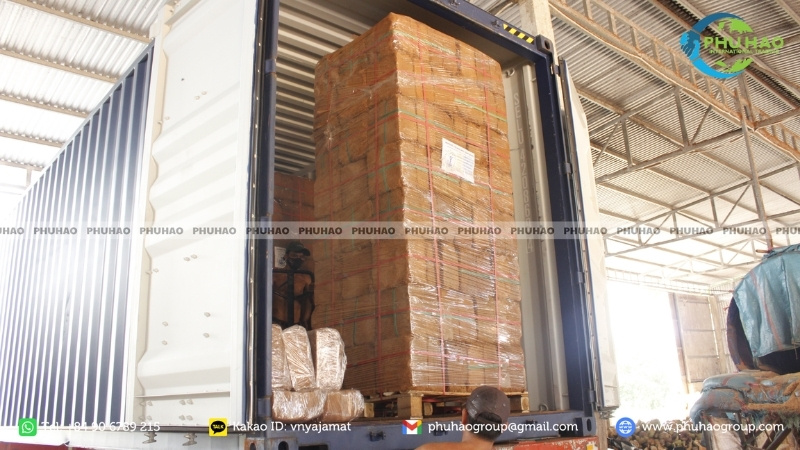
5kg compressed blocks packed securely with protective shrink film on international export pallets
Securing smooth customs clearance with international buyers requires verifying compliance with export coco peat technical standards through thorough testing of salinity, acidity, and dry matter content before cargo leaves the factory.
| Technical Parameter | Standard Export Threshold | Common Testing Method | Horticultural Benefit |
| Electrical Conductivity (EC) | < 0.5 mS/cm (Low EC grade) | 1:1.5 volume extraction method | Protects tender root tips and prevents salt burn |
| pH Range | 5.5 – 6.5 | Direct measurement in saturated extract | Facilitates root uptake of fertilizers and trace elements |
| Maximum Moisture Content | 10% – 15% | Periodic oven-dry moisture testing | Lowers ocean freight costs and halts fungal proliferation |
| Expansion Volume | 14 – 15 L/kg compressed block | Saturated water absorption measurement | Determines actual rehydrated yield during cultivation |
| Short Fiber Ratio | < 5% (dry weight basis) | Mechanical size screening | Retains optimal porosity and keeps root zones well aerated |
| Mechanical Impurities | < 1.5% | Water flotation and gravity separation | Removes stones and sand, maintaining substrate uniformity |
Coconut palms naturally thrive in coastal, brackish conditions, leaving raw husks saturated with sodium and potassium ions. Skipping intensive freshwater leaching leaves residual salts that draw moisture out of plant roots via reverse osmosis, quickly withering young shoots. International commercial contracts require verified compliance: electrical conductivity EC < 0.5 mS/cm; pH range 5.8 – 6.5; moisture < 15%; Dutch RHP certification; OMRI certification to certify physical purity and chemical stability. Maintaining export coco peat technical standards at a low EC threshold gives growers total confidence during crop feeding programs.
Raw, untreated coconut husks contain high levels of astringent tannins, which destabilize irrigation water chemistry and retard root development. Stabilizing pH levels between 5.8 and 6.5 establishes an optimal rootzone environment comparable to fertile soil, allowing plants to dissolve and absorb essential minerals readily. Adherence to export coco peat technical standards for pH levels drives active beneficial microbial colonies around roots while preventing sudden medium acidification or nutrient lockouts.
Following the washing stages, processors spread coco peat onto clean concrete drying yards or pass it through rotary thermal dryers to reduce moisture below 15%. Controlling export coco peat technical standards regarding dry moisture levels prevents compressed blocks from sweating or generating mold inside sealed ocean containers during long sea transit. Once commercial growers rehydrate the compressed blocks, each block expands vigorously into a porous, moisture-retentive substrate that retains ample air space for root respiration.
Beyond chemical concentrations, mechanical cleanliness and biological safety remain decisive factors for quarantine inspection and customs entry into global markets.
When monitoring export coco peat technical standards during raw coconut husk crushing, processors must carefully treat sand dust and irregular short fibers. Bypassing multi-deck vibrating screens causes fine dust particles to settle at container bottoms during irrigation, compacting the rootzone and choking root air channels. Strict implementation of export coco peat technical standards eliminates fine dust and gravel, establishing a consistent particle structure that keeps the growing medium naturally airy throughout the crop cycle.
During aerobic windrow composting, internal core temperatures reach 55°C to 65°C, destroying harmful pathogens, weed seeds, and insect larvae. To satisfy export coco peat technical standards, processing facilities must turn compost windrows regularly to ensure proper aeration. This controlled thermal treatment yields a clean, biologically stable, and inert finished substrate ready for precision fertilizer blending in modern commercial greenhouses.
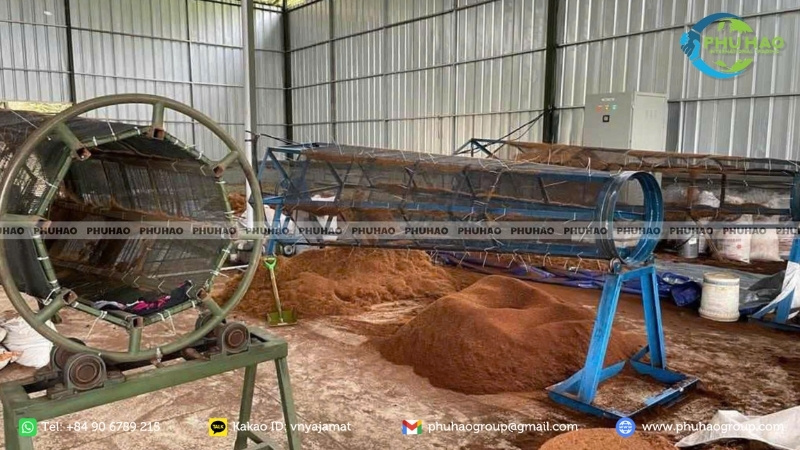
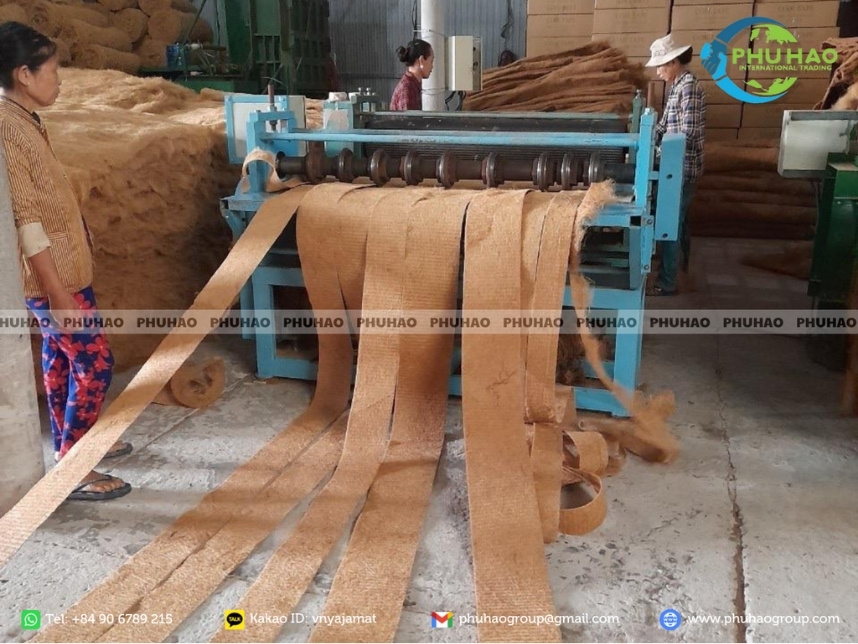
Mechanical screening lines isolate and remove coarse impurities, preserving clean, uniform, and fine coco peat so PHUHAOGROUP maintains steady export quality
Verifying whether an export shipment satisfies horticultural specifications requires structured, standardized sampling procedures rather than subjective visual checks.
During pre-shipment inspections, quality assurance technicians use specialized core triers to extract random composite samples from different pallet positions throughout the container. Technicians blend and reduce these subsamples systematically before dispatching them to independent testing laboratories to verify export coco peat technical standards. Executing export coco peat technical standards correctly right from the sampling phase ensures maximum precision in testing EC levels, moisture content, and expansion volumes, establishing transparent legal verification for both buyer and seller.
To protect commercial interests across long maritime shipping routes, an agreed Technical Data Sheet (TDS) forms an integral part of the international sales contract. Defining clear allowable tolerances for export coco peat technical standards allows both trading partners to cross-check cargo specifications smoothly upon arrival at destination ports. Complete clarity regarding every technical parameter builds long-term commercial trust between manufacturers and global agricultural enterprises.
>>> READ MORE: Specifications Of 5kg Compressed Coco Peat Block Export To South Korea: Dimensions And 40HC Container Loading Capacity
How does measuring coco peat EC using the 1:1.5 extraction method differ from the 1:2 ratio?
The 1:1.5 extraction ratio measures mineral salt concentrations closely reflecting practical substrate compaction, whereas the 1:2 ratio produces a more diluted reading.
Why must export coco peat undergo tannin washing and salinity (EC) control?
Washing removes excess mineral salts that burn delicate root tips and flushes out astringent tannins, allowing plant roots to absorb fertilizers efficiently.
Which phytosanitary certificates and COA documents are required to export coco peat to the US, Europe, and South Korea?
Consignments require an official Phytosanitary Certificate, a Fumigation Certificate, and a Certificate of Analysis (COA) detailing physical and chemical parameters.
Transforming raw coconut husks into high-grade horticultural substrates for sustainable agriculture requires dedicated engineering and strict quality management. We continuously refine our washing and screening processes to meet export coco peat technical standards with precision, providing maximum convenience to commercial greenhouse growers worldwide. Every dispatched container supplies clean nutrition to crops and advances eco-friendly agricultural cultivation. Strict adherence to export coco peat technical standards represents our solid commitment to uniform quality and dependable performance in every shipment. Connect directly with our export team at +84 90 6789 215 to discuss your technical specifications and receive detailed quotations!
Contact us for a detailed FOB & CNF quotation:
PHU HAO INTERNATIONAL TRADING CO., LTD (PHUHAOGROUP)
📞 Tel/WhatsApp/WeChat/Zalo: +84 906 789 215
📧 Email: phuhaogroup@gmail.com / henry@phuhaogroup.com
🌐 Website: www.phuhaogroup.com
🏬 Alibaba: phuhaogroup.trustpass.alibaba.com
▶️ YouTube: @phuhaogroup
You have0products in your cart
There are no products in the cart.
Total order price