18 Oct, 2026
Coco peat serves as a specialized, porous growing medium produced from secondary organic coconut husks. Specialized processing removes natural tannins, lignin, and raw salts to create international-standard Ben Tre greenhouse hydroponic substrate. Its porous capillary structure retains moisture while delivering optimal aeration for root zones. In smart farming systems, this medium maximizes nutrient solution uptake, prevents root pathogens, and drives crop yields. PHUHAOGROUP guarantees physical uniformity and high biological purity across every consignment.
Coco peat is an organic biological substrate processed from the mesocarp of coconut husks. The production integrates ion-washing techniques and calcium nitrate buffering to greenhouse agricultural standards. This process optimizes cation exchange capacity and promotes uniform root development for high-tech crops.
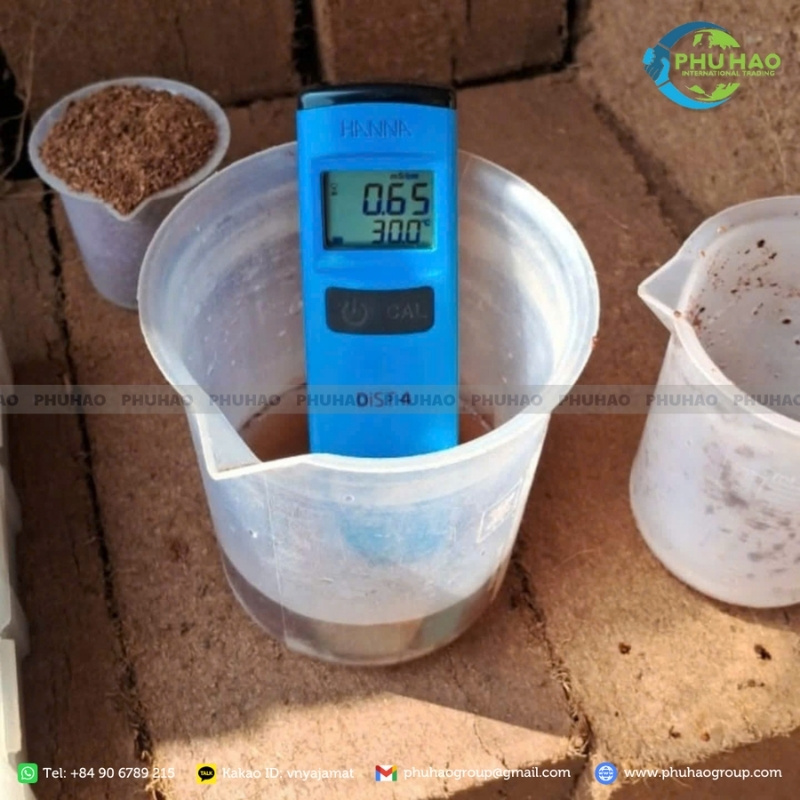
Standard testing of pH 5.5–6.5 at the PHUHAOGROUP factory protects root capillarity; contact hotline +84 906 789 215 for a detailed COA report
Raw coir pith contains significant levels of natural mineral salts from coastal harvesting regions. Free sodium (Na+) and chloride (Cl-) ions push raw electrical conductivity (EC) above 2.5 mS/cm, which burns young root tips and triggers secondary toxicity. High-grade export coco peat requires reducing EC to below 0.5 mS/cm through counter-current freshwater washing cycles under high pressure. Complete removal of saline ions ensures smooth nutrient uptake and protects root capillaries against adverse osmotic pressure.
The cation exchange capacity (CEC) of raw coir substrate ranges from 60 to 130 meq/100g, driven by natural negative surface charges on the particles. Without buffering, this matrix locks up calcium and magnesium from irrigation solutions while releasing sodium and potassium, causing severe nutrient imbalances. The factory treats the material with calibrated calcium nitrate [Ca(NO3)2] solutions to displace harmful cations and stabilize the pH range between 5.5 and 6.5. This process allows coco peat to release micronutrients efficiently and prevents physiological blossom-end rot.
The microstructure of coir pith consists of a microscopic porous network bonding short organic fibers. Premium coco peat holds 8 to 9 times its dry weight in water while maintaining a natural air-filled porosity of 18% to 22%. Continuous air pockets prevent localized water saturation that suffocates roots and eliminate breeding grounds for fungal pathogens in nursery pots. Abundant oxygen levels stimulate fine root hairs, making coco peat an outstanding soil replacement for closed greenhouses.
Different crops require dedicated blending ratios to optimize irrigation regimes:
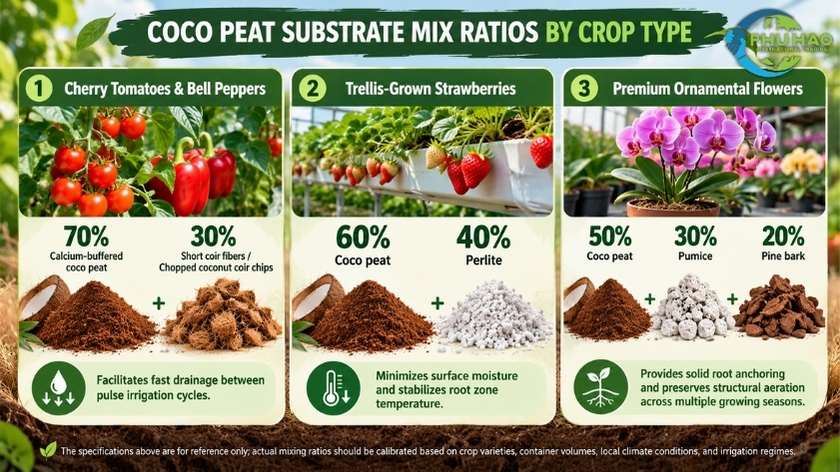
Specialized coco peat substrate formulas for cherry tomatoes, strawberries, and premium floriculture
The coco peat coco coir block 5kg product line undergoes mechanical compression in automated hydraulic presses at a 5:1 ratio, producing standard rectangular blocks measuring 30cm x 30cm x 15cm. Controlled thermal drying restricts moisture content to between 10% and 15%, stopping fungal spores and anaerobic microorganisms during storage. Particle cohesion keeps blocks intact without edge chipping during handling. Upon rehydration with clean fresh water, each block expands rapidly to yield 70 to 75 liters of fluffy growing medium. This volume recovery rate reduces labor costs and maintains uniform biological consistency across commercial greenhouses.
| Technical Parameter | Quality Standard (PHUHAOGROUP) |
| Block Dimensions | 30cm x 30cm x 15cm (±2cm) |
| Net Weight | 4.5kg – 5.0 kg/block |
| Moisture Content (MC) & Compression Ratio | 10% – 15% | Compression ratio 5:1 |
| Expansion Volume After Rehydration | 70 – 75 liters of aerated substrate |
| Packaging Method | Stretch-film wrapped, palletized |
| 40HC Container Payload | Up to 22 – 24 metric tons (maximizing cargo space) |
For ocean freight, PHUHAOGROUP palletizes shipments with industrial stretch wrap and heavy-duty strapping bands. Workers stack 192 blocks per pallet across 12 uniform tiers to preserve vertical alignment. This precise stacking pattern fits 26 pallets of compressed coco peat blocks inside a 40HC container, yielding an aggregate net payload of 22 to 24 metric tons. Heavy wrap shields the cargo from sea mist and ambient humidity, while strapping bands prevent cargo shifting during forklift handling at discharge ports. Maximizing container cubage lowers ocean freight costs per unit.
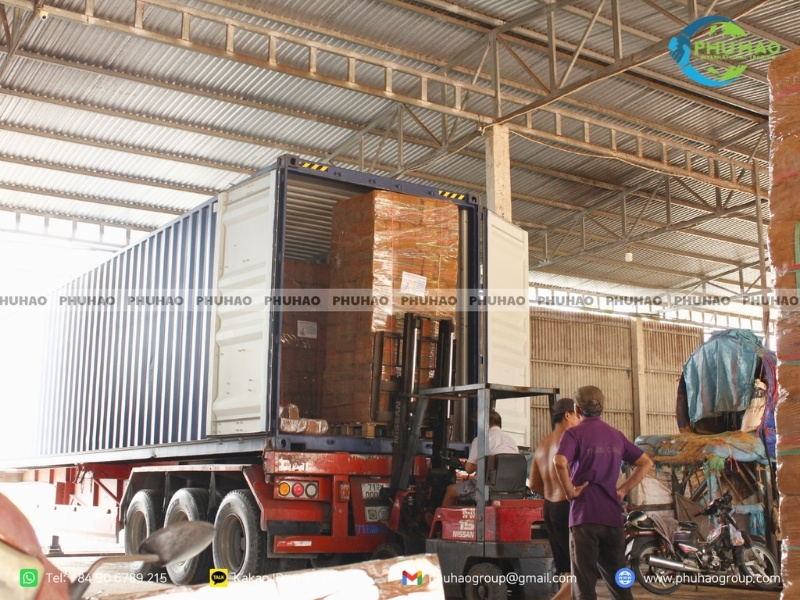
5kg blocks palletized and wrapped to reach 22–24 metric tons per 40HC container at PHUHAOGROUP, optimizing long-haul maritime shipping costs
South Korea enforces strict quarantine regulations on imported agricultural by-products to prevent invasive organisms. Technicians fumigate cargo containers thoroughly with approved compounds following international quarantine protocols. Before customs officers affix container bolt seals, the local Plant Quarantine Sub-Department inspects the consignment at the port or stuffing depot, draws samples for pest analysis, and issues an official Phytosanitary Certificate. South Korea’s Animal and Plant Quarantine Agency (APQA) verifies container identifiers, seal numbers, and botanical substrate classifications, allowing swift port entry at Busan or Incheon without demurrage delays.
PHUHAOGROUP prepares a complete export clearance dossier featuring an independent Certificate of Analysis (COA) issued by inspection bodies such as SGS or Quatest. The COA provides verified test values for EC, pH, moisture, sand/impurity percentages, and parasitic nematode screenings. Additionally, securing a Certificate of Origin (C/O) Form AK (ASEAN–Korea Free Trade Agreement) or Form VK (Vietnam–Korea Free Trade Agreement) grants importers a 0% preferential tariff rate. The shipping documentation package includes commercial invoices, packing lists, and ocean bills of lading with precise cargo descriptions. Standardized electronic customs filings from the packing warehouse to Cat Lai Port eliminate administrative bottlenecks.
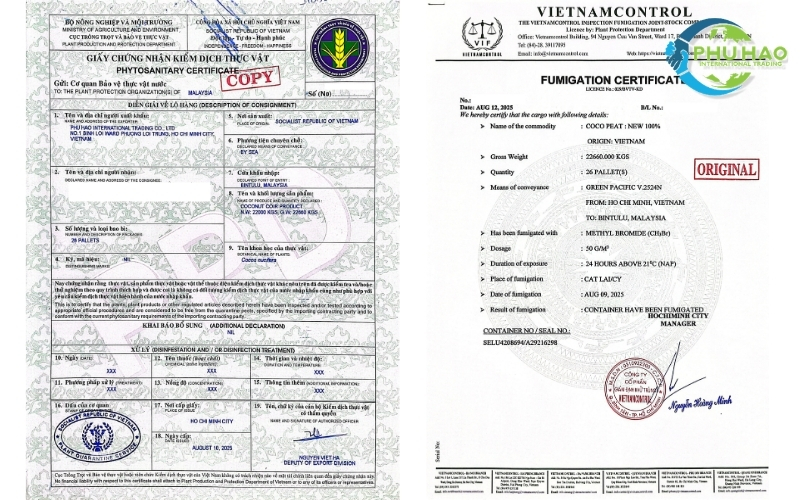
International phytosanitary certificates and fumigation documentation accompanying export coco peat consignments from PHUHAOGROUP
Why should commercial high-tech greenhouses use coco peat?
The substrate remains free of soil-borne pathogens, provides exact control over EC and pH, retains substantial moisture, and maintains superior aeration to stimulate root vigor.
How does calcium nitrate [Ca(NO3)2] buffering differ from basic lime soaking?
Lime soaking merely neutralizes surface acidity temporarily. In contrast, calcium nitrate buffering displaces bound sodium (Na+) ions through thorough cation exchange, stabilizing substrate chemistry for long-term feeding.
How many liters of substrate does a rehydrated 5kg block yield?
After absorbing clean fresh water, each 5kg block yields 70 to 75 liters of aerated, ready-to-use substrate.
Does compressed coir pith develop mold or lose expansion volume during prolonged warehouse storage?
Restricting moisture below 15% prevents fungal growth and preserves full expansion capacity for up to two years.
Converting coconut coir by-products into high-grade organic substrates transforms clean commercial agriculture worldwide. Rigorous control over electrical conductivity, pH stabilization through buffering, and precision hydraulic baling minimize biological risks in modern greenhouse operations. Export supplies from PHUHAOGROUP deliver uniform crop productivity while reinforcing circular agricultural practices in the Mekong Delta. Every dispatched container reflects uncompromising technical standards, satisfying exacting import barrier regulations in overseas markets. Investing in standardized organic substrates secures a resilient foundation for long-term agricultural success.
Contact us for a detailed FOB & CNF quotation:
PHU HAO INTERNATIONAL TRADING CO., LTD (PHUHAOGROUP)
📞 Tel/WhatsApp/WeChat/Zalo: +84 906 789 215
📧 Email: phuhaogroup@gmail.com / henry@phuhaogroup.com
🌐 Website: www.phuhaogroup.com
🏬 Alibaba: phuhaogroup.trustpass.alibaba.com
▶️ YouTube: @phuhaogroup
You have0products in your cart
There are no products in the cart.
Total order price