04 Sep, 2026
Incorrect coir mat dimensions caused by shrinkage after unrolling are a common issue that arises when workers cut strapping bands on site. This technical challenge often leads to disputes over commercial acceptance between manufacturers and B2B clients. The underlying problem stems from the interaction between the resilient twisted-fiber matrix and the prolonged static compression experienced during international shipping in containers. By understanding these micro-physical mechanisms, observing international geotextile tolerance benchmarks, and implementing standardized tension-measurement protocols, project developers can address and resolve apparent dimensional discrepancies smoothly.
Incorrect coir mat dimensions caused by post-unrolling shrinkage refer to a condition where the physical length or width of a coir mat deviates from original factory specifications once unrolled. This issue arises when coconut fibers release built-up compressive strain after being rolled under high pressure for extended periods, along with ongoing changes in ambient humidity.
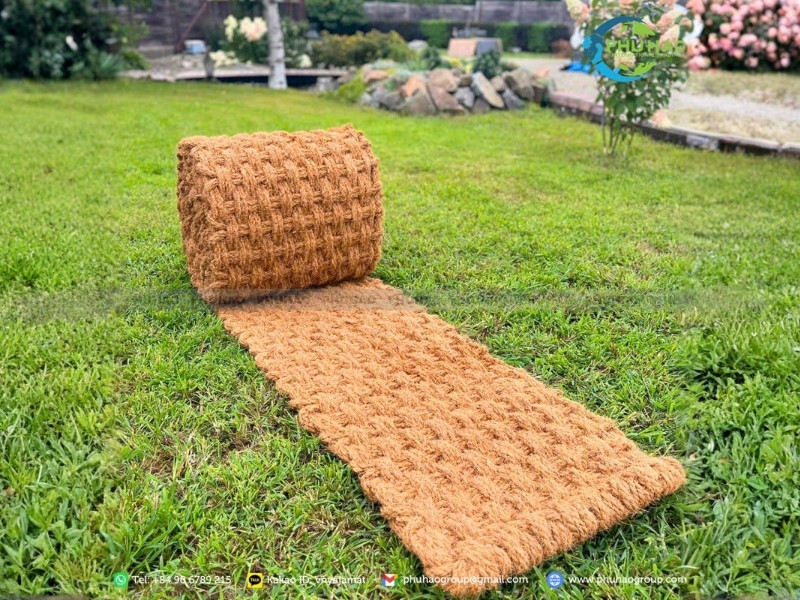
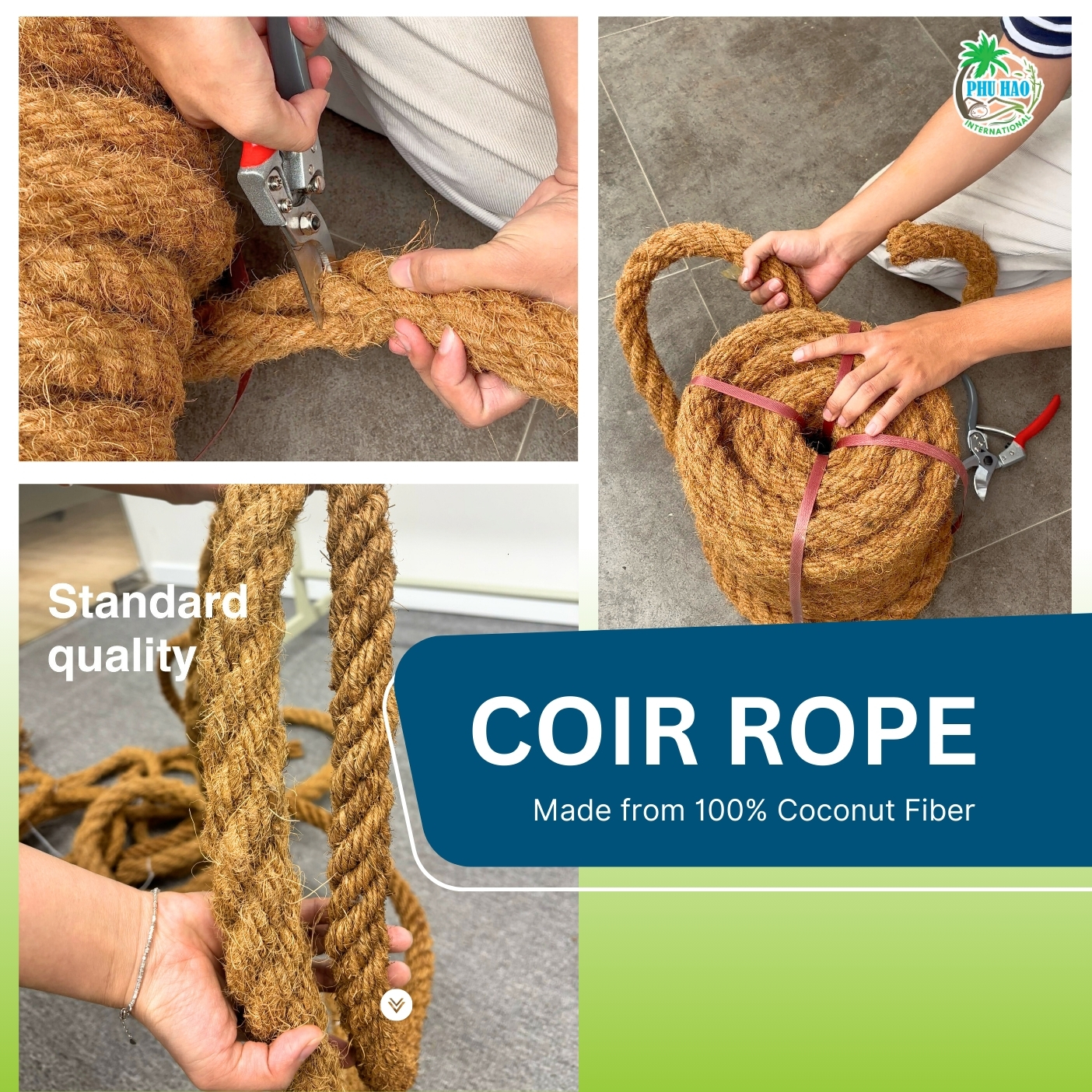
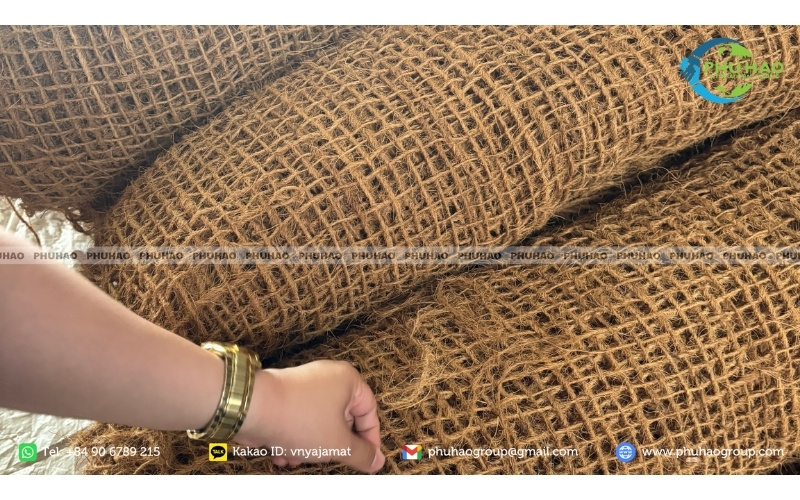
Inspecting incorrect coir mat dimensions caused by post-unrolling shrinkage on a 10m roll at the job site
The phenomenon of coir mat shrinkage after cutting binding straps stems from the inherent physical characteristics of natural fibers. Opening a 10m or 20m roll can reveal an apparent deficit of 50cm to 70cm. Two primary mechanical forces govern this contraction.
Coir fiber spinning twists multiple single strands into sturdy twines, which weave horizontally and vertically into an elastic structural grid mimicking millions of microscopic springs. Industrial weaving looms keep yarns under constant tension during flat production. Severing the packaging bands unleashes this stored energy, pulling the fibers back toward their resting state and causing apparent incorrect coir mat dimensions right after deployment.
Hydraulic balers exert tremendous tension during rolling before crews stack the units multiple tiers high inside a 40HC container. Continuous static compression across maritime transit routes leads to extreme internal stress accumulation. Rapid unpackaging triggers instantaneous weave contraction, generating incorrect coir mat dimensions upon rollout.
Variations in coir matting dimensions are influenced by storage climates and mechanical weaving parameters. Atmospheric moisture fluctuations coupled with specific yarn densities introduce predictable physical contraction factors across commercial consignments.
Coir fiber is an organic cellulosic material that is sensitive to ambient relative humidity. Mills regulate export moisture levels at 15% – 18%. During transit through cold, dry climates or when stored in dry warehouses, fibers release moisture rapidly. This process leads to micro-shrinkage within individual filaments. This widespread cellular contraction shortens the overall mat length, showing up as incorrect coir mat dimensions upon unrolling.
Structural configurations dictate how fast coir matting regains its shape. Heavy-twine mats or high-density specifications (30mm – 50mm thickness) resist downward loading and surface abrasion far better than thinner grades.
However, when rolls remain tightly bound for months, dense interlocking fibers generate immense static friction between compressed layers, preventing the mat from snapping back to nominal dimensions right away. Consequently, thick coir rolls exhibit a longer mechanical recovery lag and show short lengths when measured immediately after cutting the bands.
To preserve objective benchmarks in global trade, geotextile testing bodies define clear regulatory frameworks to evaluate apparent incorrect coir mat dimensions after unrolling.
According to ASTM D5199 and ASTM D5261, the allowable mat length tolerance for natural geotextiles ranges from ±3% to ±5% against declared label values. Shortfalls registered under initial incorrect coir mat dimensions fall strictly within this allowable threshold and do not constitute manufacturing defects.
QA/QC inspection teams use comparative GSM and yarn density metrics to evaluate incorrect coir mat dimensions:
| Technical Inspection Criteria | Compliant Product (Compression Shrinkage) | Non-Compliant Product (Defective Shortfall) |
| Grammage / Unit Area Mass (GSM) | Localized GSM increases (6,800 – 7,200 g/m²) | Localized GSM remains unchanged or drops (< 6,000 g/m²) |
| Total Coir Roll Weight | Retains 100% nominal mass (e.g., a 1m x 10m x 35mm roll weighs 65kg) | Actual mass shows a shortfall > 5% – 7% below specification (Under 61kg) |
| Warp/Weft Yarn Density (Lines/m) | Step density per linear meter rises as compacted yarns pack tightly | Step density stays sparse, matching or falling below planned counts |
| Response to Rated Tensile Pull (50N – 100N) | Mat length recovers to 100% of nominal manufacturing specs | Mat fails to stretch out to committed contract dimensions |
| Technical Inspection Finding | Temporary elastic deformation; fully meets B2B technical acceptance standards | Material deficiency due to short production; fails acceptance |
This benchmark matrix proves that compression-induced incorrect coir mat dimensions do not reduce total raw material volume across the shipment.
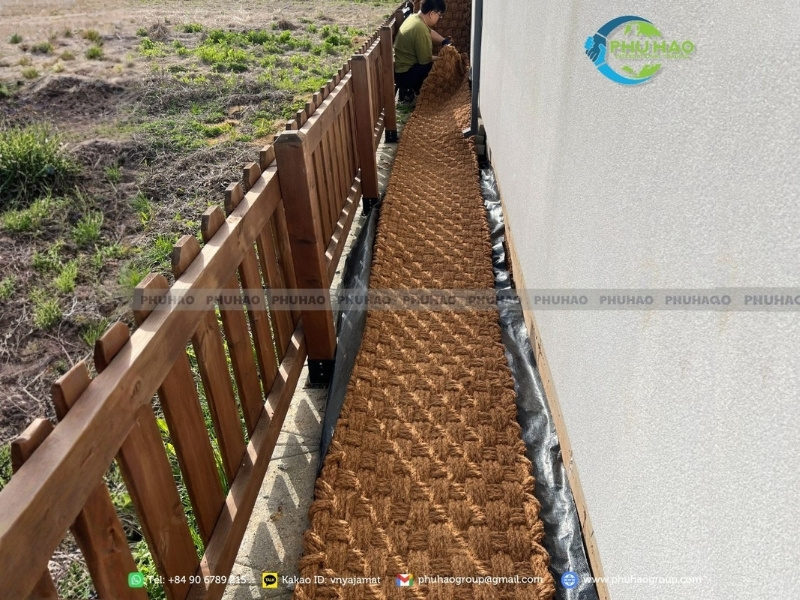
Securing and tensioning mat edges under ASTM guidelines to eliminate incorrect coir mat dimensions and verify exact handover length
A standardized field method for coir roll measurement serves as the definitive basis to clarify apparent incorrect coir mat dimensions and protect rights under B2B supply agreements.
Never inspect mats immediately upon severing packaging straps. Site engineers should lay the mat flat on a clean, dry surface for 24 to 48 hours. This stabilization phase rebalances fiber moisture and releases deep compressive strain accrued during ocean transit.
Anchor one end securely and apply an axial pull force between 50N and 100N along the length. This tension pulls out undulations without straining the underlying matrix. Run a calibrated steel tape down the roll centerline to verify dimensions and rule out incorrect coir mat dimensions. Premature evaluations of incorrect coir mat dimensions create unnecessary job delays and avoidable project friction.
>>> READ MORE: Coir Mat Specification Export Korea Meeting Strict Quality Standards
Why do coir mats shrink 50cm to 70cm right after opening the straps?
Extended shipping container compression combined with the elastic recoil of tightly twisted yarns pulls the structure inward once packaging tension drops.
How do engineers distinguish packaging compression from genuine manufacturing length shortfalls?
Weigh the entire roll on certified scales and verify the dimension again after resting the mat flat under a light, rated pull force.
Do changes in fiber moisture levels distort roll dimensions?
Yes, rapid moisture loss shrinks cellulosic microfibers, noticeably decreasing the measured overall length.
How long should an unrolled coir mat rest before field crews record official acceptance measurements?
Let the mat lie flat without tension for 24 to 48 hours to release residual mechanical compression.
Do single-yarn or double-yarn coir mats show higher shrinkage and dimensional recovery rates after baling?
Double-yarn mats shrink more and take longer to recover full nominal dimensions due to their dense structural mass.
Eliminating disputes stemming from incorrect coir mat dimensions forms the foundation of quality assurance at PHUHAOGROUP. Our production infrastructure maintains closed-loop quality tracking: harvesting mature Ben Tre coconuts, applying uniform yarn twisting, and weaving on precision machinery.
Our logistics engineers optimize every 40HC container packing plan to mitigate sustained compressive strain on roll structures. Our technical field specialists assist global B2B clients in setting up standardized receiving protocols that systematically resolve incorrect coir mat dimensions. Contact our team to receive comprehensive technical data sheets.
Contact us for a detailed FOB & CNF quotation:
PHU HAO INTERNATIONAL TRADING CO., LTD (PHUHAOGROUP)
📞 Tel/WhatsApp/WeChat/Zalo: +84 906 789 215
📧 Email: phuhaogroup@gmail.com / henry@phuhaogroup.com
🌐 Website: www.phuhaogroup.com
🏬 Alibaba: phuhaogroup.trustpass.alibaba.com
▶️ YouTube: @phuhaogroup
You have0products in your cart
There are no products in the cart.
Total order price