29 Sep, 2026
The coir log installation procedure provides an effective green solution that protects canal slopes and riverbanks from scouring under turbulent water currents. This technique combines densely compressed natural coconut fiber rolls with a robust staking system, creating a protective barrier that dissipates wave energy and prevents bed erosion along bank toes. Consequently, canal subsoil maintains high cohesion without mechanical subsidence. By executing site surveys, grading canal slopes, installing securing stakes, and establishing deep-rooting vegetation correctly, field crews ensure structural stability through multiple flood seasons.
The coir log installation procedure requires strict quality control over foundation trench compaction, stake driving angles, and joint tightness between fiber rolls. Field crews must integrate interlocking anchor stakes with crisscross top lashings to cancel hydrostatic uplift and prevent sub-toe undermining along canal banks.
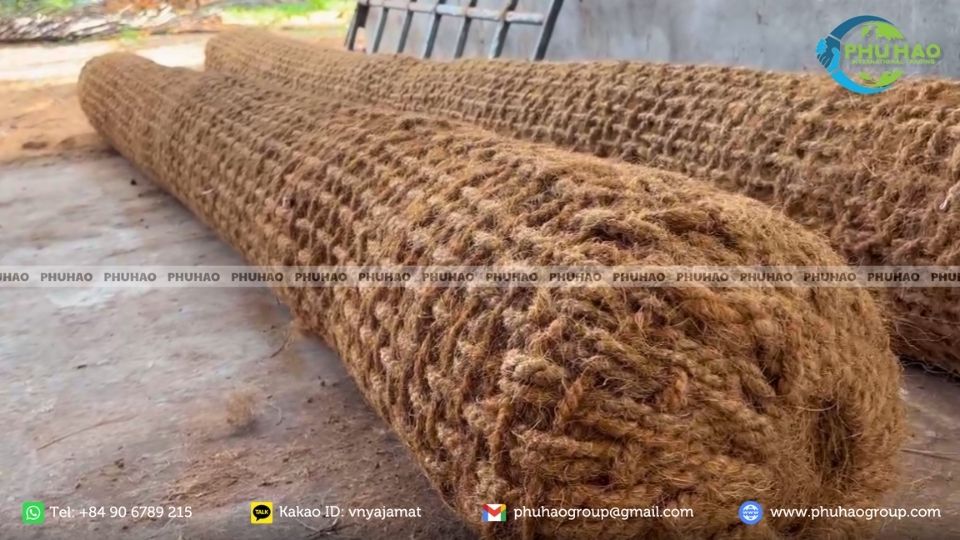
Inspecting dense coir fiber structure before executing the coir log installation procedure minimizes toe scour risks
To withstand strong hydraulic forces, selecting materials before beginning the coir log installation procedure on site remains essential. Certified materials ensure structural flexibility without displacement or distortion during severe high tides.
| Material Item | Standard Specifications & Dimensions | Mechanical & Physical Requirements |
| Coconut fiber roll (coir log) | Diameter 30–35 cm; Length 2 m or 4 m | 100% compressed coir fiber (130–160 kg/m³); double-twisted outer mesh |
| Anchor stakes | Melaleuca or eucalyptus wood; Diameter 60–80 mm; Length 1.2–1.5 m | Straight trunk, chiseled tip; driven ≥ 0.8 m into ground |
| Binding twine | Coir twine lashing; Diameter 4–6 mm | High tensile twisted coir yarn; natural biodegradation |
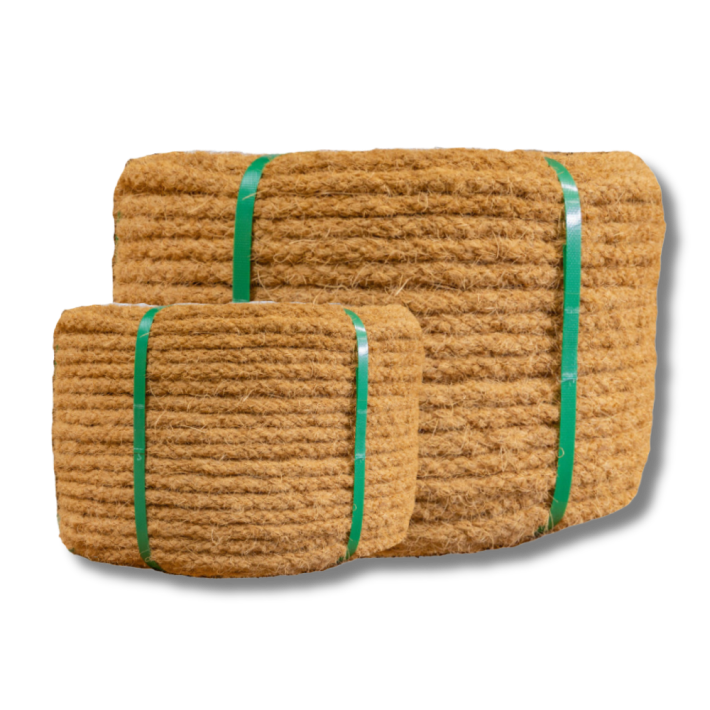
A coir log used in canal reinforcement typically measures 30 to 35 cm in diameter and comes in 2 m or 4 m lengths manufactured to precise standards by PHUHAOGROUP. Internally, the log contains 100% natural coconut fibers compacted to a dry density of 130 to 160 kg/m³ to resist deformation under wave impact. The outer casing uses high-tensile coir netting with a uniform mesh opening of 3 to 5 cm, retaining internal fibers tightly while preventing fiber debris loss into waterways.
Anchor stakes secure the coir cylinder deep into subgrade soil. Installation crews should select straight melaleuca or eucalyptus poles with diameters of 60 to 80 mm and lengths of 1.2 to 1.5 m, sharpened at the tip to ease ground penetration. Cross-tie assemblies use tough 4 to 6 mm coir twine lashing, offering high tensile endurance against outdoor exposure and decomposing naturally once deep vegetation root systems anchor firmly into virgin earth.
Adhering strictly to geotechnical practices during the coir log installation procedure eliminates sub-toe scour risks and prevents riverbank undercutting entirely.
Workers grade slope surfaces to match design inclinations, clearing loose debris to create an even, clean bed. Next, technicians carry out toe trench excavation parallel to the low-water line at a depth equal to one-third to one-half of the log diameter. Tamping the trench base flat and removing sharp rocks or dead tree roots ensures continuous surface contact between the roll and soil, cutting off subsurface water seepage beneath the revetment foundation.
Using optical levels and taut string lines, workers set straight, uniform reference marks along the canal edge. Place each coconut fiber roll directly into the prepared toe trench, seating the base flush against the native bed. Tight contact between soil and revetment elements prevents swirling currents from washing away foundation material.
To maintain log stability against hydraulic uplift during the coir log installation procedure, driving staggered wooden staking pairs along both flanks serves as an essential anchor. Space stakes 0.8 to 1 m apart, driving them at an inward 10 to 15-degree angle toward the log center to form a firm mechanical clamp. Drive stake points at least 0.8 m into firm subsoil, leaving heads 5 to 10 cm above the log crown to tie diagonal X-pattern coir lashings that prevent drift during rising tides.
Where adjacent rolls meet, workers butt the ends tightly together, keeping gaps under 20 mm. Thread braided coir twine through adjacent outer mesh loops using repeated cross-stitches to form a continuous linear barrier. Securing these butt connections keeps the revetment alignment from separating or shifting when current velocities peak.
Once logs sit locked in place, backfill fertile, friable topsoil behind the revetment crest and tamp lightly to grade. The team then proceeds with planting vetiver aquatic grass or indigenous reed varieties directly into the backfilled soil and between outer mesh crevices on the log crown. Vetiver develops massive root structures that penetrate coir layers and bind deep into parent soil, generating mechanical shear resistance that stabilizes banks over many years.
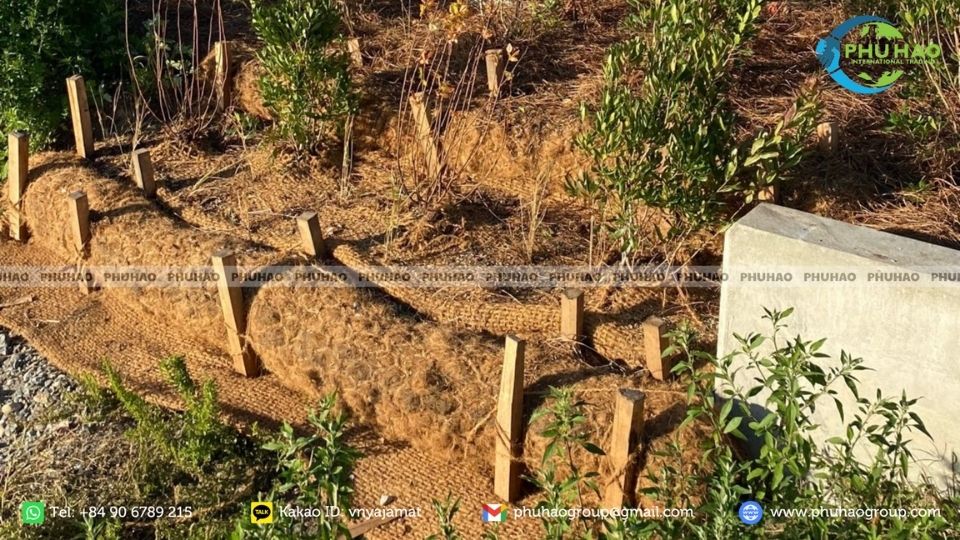
Driving timber stakes 0.8 m deep locks coir rolls securely in place, extending bank project service life past 5 years of continuous service
Following field operations, quality supervisors survey physical metrics to confirm that the coir log installation procedure satisfies project engineering specifications.
After the initial tidal surge or heavy flood event, the inspection team re-evaluates bank geometry. Vertical settlement of fiber rolls must not exceed 5% of design diameter, while alignments must stay straight without lateral displacement. Stake lashing twines must stay taut, validating load resistance against design runoff stresses.
Biological acceptance inspection takes place 30 to 60 days post-planting. Aquatic grasses must take healthy root with an 85%+ survival rate, extending root networks 15 to 20 cm through coir interiors into underlying soil. Dense foliage across slope faces confirms the success of the coir log installation procedure in holding native soils naturally.
>>> READ MORE: Coir Log Density Specifications (Diameter 20cm To 50cm): Weight Standards And Load Capacity
What are the standard spacing and depth requirements for coir log anchor stakes?
Drive timber stakes in staggered pairs 0.8 to 1 m apart, penetrating load-bearing soil layers to a minimum depth of 0.8 to 1.2 m.
How should contractors lace joint ends to prevent openings during high currents?
Butt roll ends tight together and lace heavy coir twine through outer mesh apertures using alternating cross-stitches.
How do you prevent plantings on coir logs from dying during extended flood inundation?
Choose flood-tolerant varieties like mature vetiver tillers or wetland sedges, placing root crowns slightly higher along the upper log crest.
Will riverbanks erode again if coir rolls decompose before roots anchor the slope?
No. Coir logs require 3 to 5 years to decompose completely, leaving abundant time for vegetative roots to anchor deeply into bank substrates.
Bioengineered revetments stabilize earth embankments permanently, reduce thermal reflection, and preserve riparian ecosystems. Completing the coir log installation procedure according to design specifications creates an optimal nursery for vegetation. As coconut fibers decompose over 3 to 5 years, dense interlaced root matrices replace them permanently. Unlike rigid concrete dikes that risk fracture, flexible soft bio-revetments adjust dynamically to ground subsidence. PHUHAOGROUP supplies certified materials and offers engineering support directly via phone at +84 90 6789 215. Executing a sound coir log installation procedure delivers exceptional erosion control, minimizes maintenance expenses, and preserves natural waterways.
Contact us for a detailed FOB & CNF quotation:
PHU HAO INTERNATIONAL TRADING CO., LTD (PHUHAOGROUP)
📞 Tel/WhatsApp/WeChat/Zalo: +84 906 789 215
📧 Email: phuhaogroup@gmail.com / henry@phuhaogroup.com
🌐 Website: www.phuhaogroup.com
🏬 Alibaba: phuhaogroup.trustpass.alibaba.com
▶️ YouTube: @phuhaogroup
You have0products in your cart
There are no products in the cart.
Total order price