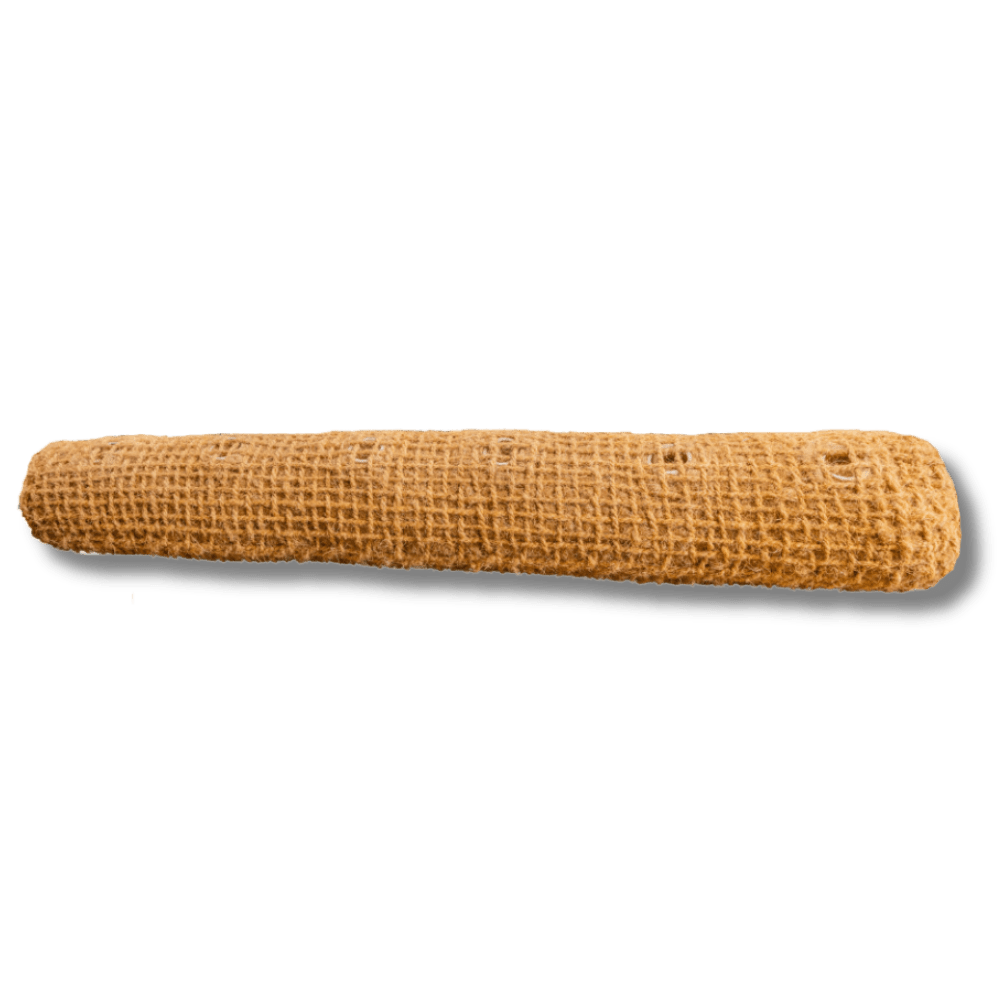
28 Sep, 2026
Coir log density specifications govern hydrodynamic flow control and slope stability across bioengineering revetments on riverbanks and natural canals. When deploying organic bank stabilization using agricultural by-products, understanding coir fiber mechanics helps field teams prevent foundation piping. Strict compaction criteria guarantee hydraulic shear resistance while preserving core integrity against continuous water erosion.
Coir log density specifications dictate eddy energy dissipation, hydraulic shear strength, and bank seepage control. This index ensures coir logs maintain their nominal geometric cross-section, preserving structural stability for three to five years until vegetative root networks anchor the bank permanently.
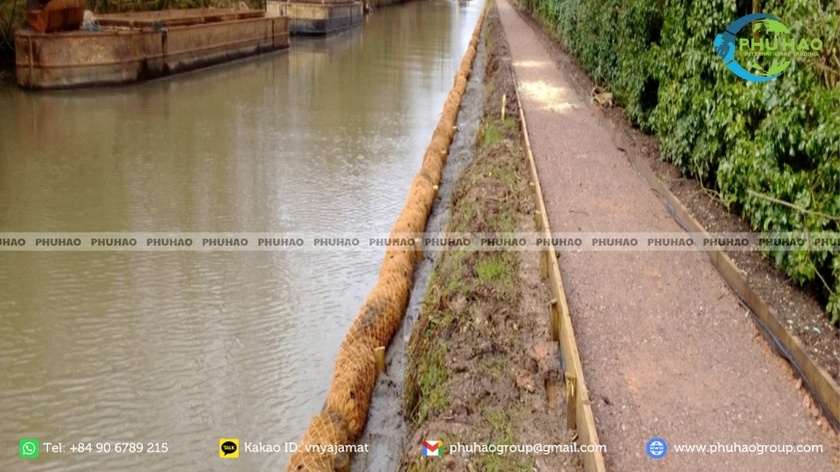
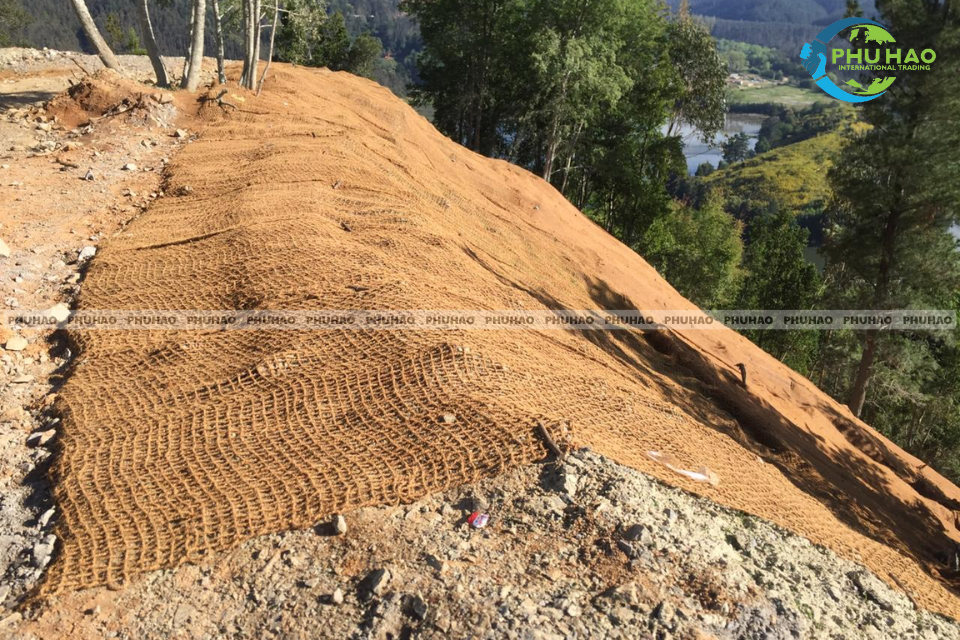
Field-grade coir log density specifications for D35cm units stabilize embankment toes against strong tidal surges; contact PHUHAOGROUP for engineering consultation today
Standard compaction metrics converting between density kg/m3 lbs/cu.ft and metric units comply with nominal thickness testing under ASTM D6525:
| Pipe Specification (Diameter x Length) | Nominal Cross-Section (m2) | Design Density | Standard Dry Weight | 40HC Container Packaging Standard |
| D30-35cm x 2m (Densely Packed) | 0.0707 – 0.0962 | 140-160 kg/m3 (8.7-10.0 lbs/cu.ft) | 21.00 kg/roll | 360 rolls/40HC |
| D30-35cm x 4m (Export Standard) | 0.0707 – 0.0962 | 125-145 kg/m3 (7.8-9.0 lbs/cu.ft) | 38.00 kg/roll | 180 rolls/40HC |
| Custom Sizing Reference Data | ||||
| D20cm | 0.0314 | 110-130 kg/m3 (6.8-8.1 lbs/cu.ft) | 14.00-25.00 kg/roll | 300-550 rolls/40HC |
| D40cm | 0.1257 | 140-160 kg/m3 (8.7-10.0 lbs/cu.ft) | 28.00-50.00 kg/roll | 150-270 rolls/40HC |
| D50cm | 0.1963 | 150-180 kg/m3 (9.4-11.2 lbs/cu.ft) | 40.00-63.00 kg/roll | 110-220 rolls/40HC |
Beyond custom fabrications such as diameter 20cm 30cm 40cm and 50cm, D35cm units at 2m and 4m lengths serve as the baseline for slope stabilization. Production teams stringently control coir log density specifications to ensure uniform density throughout the cylinder body. When projects require high-energy retention in tidal estuaries, design density targets the upper limits to maintain nominal cross-sections against severe hydrodynamic impact.
At the factory gate, units reflect only baseline dry weight at standard moisture contents. Submerged during tidal surges, natural coir fibers absorb 2.5 to 3.5 times their dry weight in water, generating ballast that pins the revetment toe to the bed. Coir log density specifications define internal void ratio; exact packing ensures saturated water absorption without distorting the nominal cross-section. Verifying compaction density in the field guarantees long-term embankment resilience.
Revetment erosion control relies directly on outer casing and core resistance against hydraulic loads. Under tidal action and high discharge velocities, high coir log density specifications allow cylinders to withstand bed shear stress up to 150-220 N/m2 and flow velocities of 2.5-4.0 m/s. Facing head-on waves, densely packed coir fibers dissipate impact forces via viscous friction, eliminating surface scour and organic foundation undercut. Controlled density buffers hydraulic impact without toe settlement.
At the soil-log interface, tightly packed coir matrices act as ecological reverse filters. The capillary network traps clay and fine sand from washing out during drawdown cycles while letting groundwater drain freely to relieve excess pore water pressure. Maintaining steady coir log density specifications across this contact horizon shields embankment toes from localized rotational slip.
Anchor staking requires coir rolls to absorb sustained lateral compressive stress. Built to standard, coir log density specifications protect cylinders from crushing under tension lashing or splitting under timber stake driving forces. This uniform matrix forms an integrated tension-resistant system capable of deflecting floating flotsam impact.
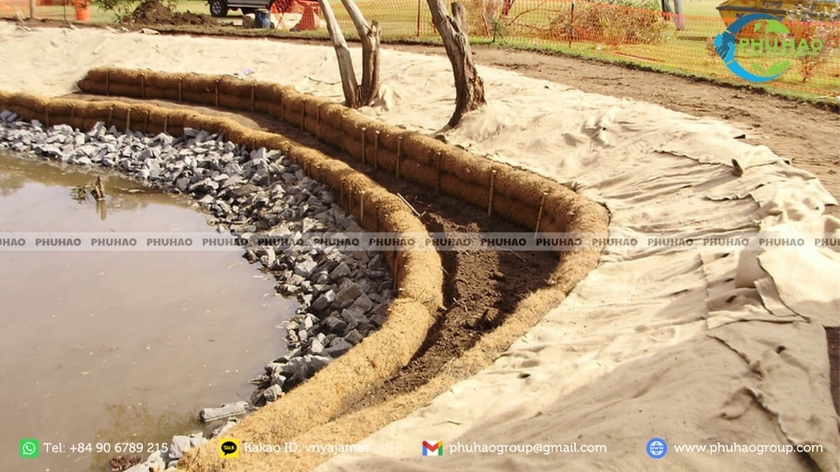
Securing wooden stakes preserves coir log density specifications against lashing deformation during green revetment installation by PHUHAOGROUP
Bidding documents and engineering descriptions must specify accurate coir log density specifications to classify manufacturing yarn grades. Specifications should require 100% pure Ben Tre coir fiber accompanied by certified density test records to facilitate transparent site inspections. Standardized density metrics give project management units a clear baseline for material verification during field handover.
Alongside custom orders across lengths of 3m and 6m, standard 2m and 4m logs optimize cargo layouts in high-cube shipping containers or flatbed trucks. By referencing coir log density specifications, estimators calculate freight payloads and establish staking layouts at 1m to 1.5m intervals with matching twine quantities. Locking in exact material densities yields accurate quantity takeoffs, eliminating unexpected jobsite expenses.
Why must engineers specify coir log density for erosion control revetments?
Standard density prevents cylinder flattening, resists hydrodynamic shear, and blocks fine sediment migration along canal banks.
Does driving stakes through the outer edge puncture the netting or lower log density?
Driving stakes through the core can tear outer netting mesh; engineers recommend staking flush against the outer perimeter of the coir roll.
How do expansion coefficients and saturated density affect toe slope stability?
Water uptake triples unit weight, applying gravity ballast that anchors the slope toe and prevents buoyant uplift.
Can crews drive timber or bamboo stakes directly through the center instead of external staking?
Engineers advise pairing twin stakes on either side joined by top notch lashing to safeguard the uniform internal density of the coir core.
Mastering coir log density specifications equips geotechnical engineers to tailor slope protection schemes across diverse aquatic environments. Whether facing soft silt-sand strata or high-velocity currents, targeting the proper coir log density specifications protects bioengineering installations through heavy seasonal floods. Manufacturer PHUHAOGROUP tests density per linear meter before dispatching shipments to project sites. For hydraulic design calculations or physical test samples, call the PHUHAOGROUP engineering team at +84 90 6789 215 to secure an effective, durable slope solution.
Contact us for a detailed FOB & CNF quotation:
PHU HAO INTERNATIONAL TRADING CO., LTD (PHUHAOGROUP)
📞 Tel/WhatsApp/WeChat/Zalo: +84 906 789 215
📧 Email: phuhaogroup@gmail.com / henry@phuhaogroup.com
🌐 Website: www.phuhaogroup.com
🏬 Alibaba: phuhaogroup.trustpass.alibaba.com
▶️ YouTube: @phuhaogroup

You have0products in your cart
There are no products in the cart.
Total order price