15 Oct, 2026
Structure of loose vs compressed coir log cores plays a decisive role in bioengineering slope stabilization. Prolonged submergence exposes erosion control structures to continuous water flow and wave action, causing structural deformation if fiber specifications fall short. A thorough evaluation of the structure of loose vs compressed coir log cores clarifies the standards for selected mature fibers, mechanical compaction density, and protective outer casings to ensure slope stabilization structures withstand severe monsoon flood seasons.
The structure of loose vs compressed coir log cores directly determines hydraulic load resistance and defines each functional zone in bank protection. High-density hydraulically compressed mature fiber stabilizes tidal toe zones, while porous, breathable fiber matrices support dry bank slopes. This design secures slope stability across riverbank reinforcement projects.
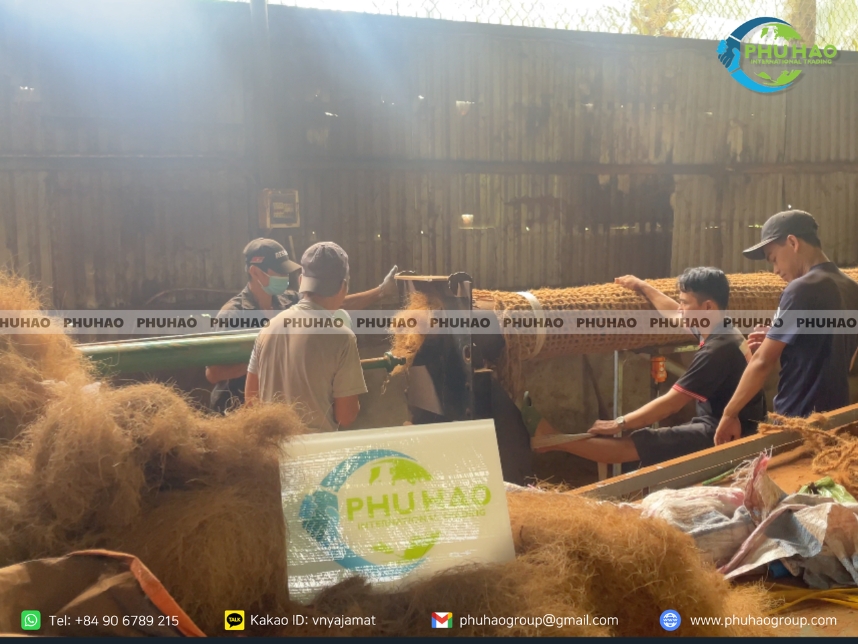
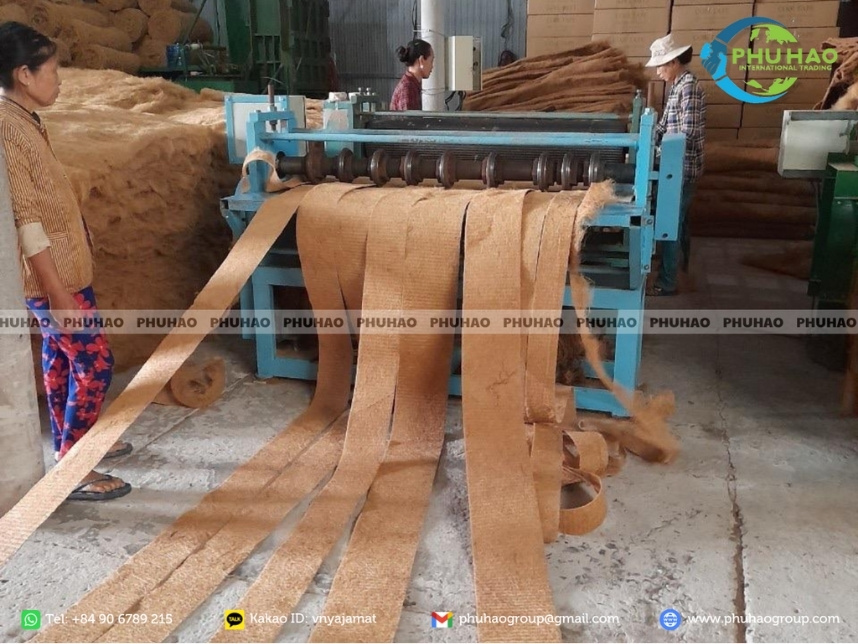
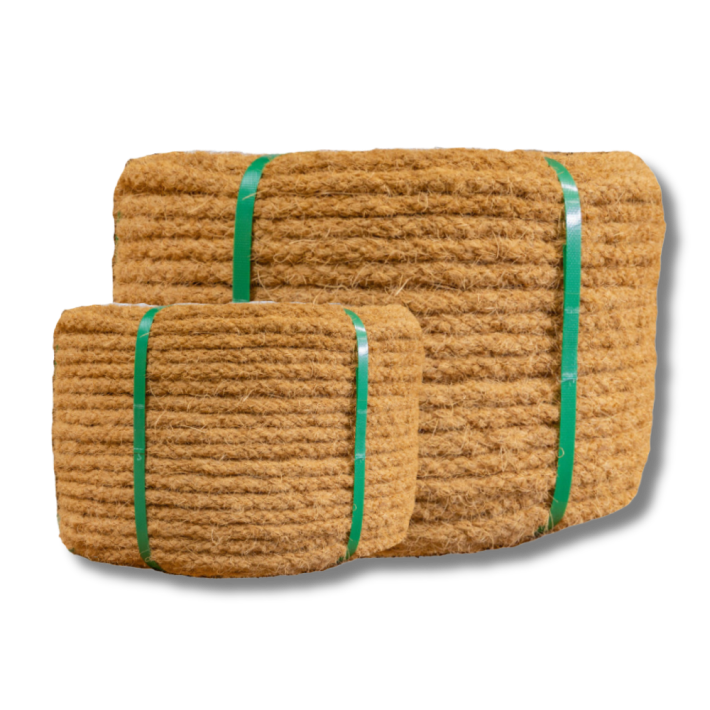
Production process of tightly compacted D35cm x 4m coir log designed for high hydraulic loads. For direct engineering and technical support, contact PHUHAOGROUP hotline: +84906789215
Wet soil stabilization demands core profiling methods that directly dictate riverbank slope lifespan. The distinction between the two filling mechanisms yields contrasting mechanical behaviors under recurring hydrodynamic forces.
Reinforcement specifications for high-velocity flows consistently prioritize uniform mechanically compressed cores. Specialized compaction equipment cross-weaves fibers multi-directionally to achieve a standard volume density between 125 and 160 kg/m³. This mechanical treatment optimizes core elasticity, preventing flattening, crushing, or sectional kinking under the heavy overburden of slope earth and rock. Even when saturated with water at 2.5 to 3.5 times its dry weight during floods, a mechanically compacted structure of loose vs compressed coir log cores retains its rigid cylindrical geometry, generating firm counter-resistance to anchor the embankment.
Unlike dense mechanical compaction, manual packing or a pneumatic stuffing machine produces a loose, porous core with substantial void spaces. Rapid currents displace loosely packed fibers toward the ends if placed in vulnerable high-energy zones. Conversely, a porous core excels at trapping fine silt, enabling aquatic plant roots to penetrate deeply while significantly cutting material costs on gentle slopes with minimal wave action. Comparing the structure of loose vs compressed coir log cores equips contractors to allocate the right materials across diverse site conditions.
| Technical Parameter | Densely Compressed Coir Core (Mechanically Compacted) | Loosely Stuffed Coir Core (Manual / Light Pneumatic) |
| Volume Density | Meets standard 125 – 160 kg/m³ | Under 80 – 100 kg/m³, porous and soft distribution |
| Geometric Stability | Retains cylindrical load-bearing geometry | Low mechanical resilience, deforms under heavy wave impact |
| Underwater Resilience | Resists scouring flows, securely stabilizes embankment toes | Rapidly traps fine silt, accelerates deep root penetration |
| Recommended Application | Submerged revetment toes, wave-impact zones, high-velocity currents | Gentle dry slopes requiring rapid revegetation and cost efficiency |
Mechanical durability in submerged coir log units depends entirely on input raw material grade. Raw coconut husk fibers harvested from mature palms in Ben Tre boast high lignin content, delivering exceptional rot resistance and saltwater endurance. Engineering standards for the structure of loose vs compressed coir log cores require rigorous fiber quality control before processing to maximize load capacity.
To prevent core disintegration under continuous submergence, engineering guidelines mandate that mature fibers measuring 15 cm to 25 cm make up at least 70% of total core mass. The remaining fraction contains graded shorter fibers, strictly excluding coir pith dust, fine coir peat, or fermentable organic waste. High-grade mature fibers form the foundation of the structure of loose vs compressed coir log cores, delivering natural rot resistance, core toughness, and long-term mechanical rebound.
Natural elasticity allows long coir mattress fiber strands to interlock multi-directionally when compressed, creating a self-locking 3D matrix. Water saturation causes fibers to expand slightly, but mechanical interlocking locks the core bundle together, neutralizing internal swelling pressure. Consequently, the structure of loose vs compressed coir log cores blocks sediment intrusion from hollowing out the casing, safeguarding load-bearing cross sections and defending banks against scouring.
Outer netting maintains geometric form and distributes hydraulic forces across the compressed fiber core underwater. Depending on on-site flow velocity, pairing standardized outer netting with the appropriate structure of loose vs compressed coir log cores optimizes structural integrity and minimizes netting tear risks. Robust fabrication in the structure of loose vs compressed coir log cores protects interior fibers against swift currents.
Natural netting woven from durable 2-ply twisted coir twine with diameters between 5 mm and 8 mm forms uniform square apertures. This eco-friendly layer shields the structure of loose vs compressed coir log cores across its initial 3 to 5-year service window. This timeframe allows vetiver grass root networks to penetrate deep into surrounding soil strata. Once dense vegetation establishes full bank grip, the outer casing of the structure of loose vs compressed coir log cores biodegrades into nutrient-rich organic matter without leaving synthetic plastic residue.
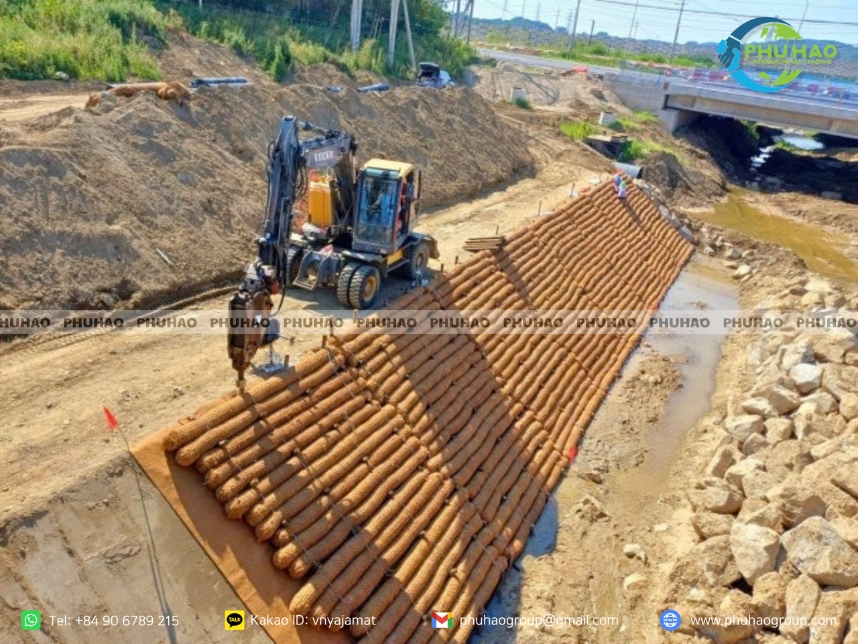
The structure of loose vs compressed coir log cores directly determines hydraulic pressure endurance and real-world riverbank anti-scour performance
To withstand turbulent eddies, hand-woven outer casing features a 5x5cm outer mesh size that distributes tensile stress evenly along the log body. The 5x5cm aperture provides space for root systems to expand while retaining mechanically compacted mature fibers inside without material loss. Double-twisted coir yarn tightly knots both ends and seals longitudinal seams, ensuring the structure of loose vs compressed coir log cores functions as a monolithic unit that resists cyclic tidal pull throughout project lifespans.
>>> READ MORE: Export Coir Log Price List 2026: Unit Rates For 20cm To 50cm Diameters And Container Volumes
What long fiber ratio standard prevents fine coir pith washout from the coir log core?
Mature fibers measuring 15 cm to 25 cm must account for at least 70% of core mass, with all fine coir dust thoroughly filtered out.
How do engineers verify coir log compaction density and fiber ratios upon delivery on site?
Inspect overall log weight against engineering specifications, press firmly by hand to ensure indentation stays under 2 cm, and examine fiber uniformity at both cut ends.
Does coir log deformation upon water saturation impair soil retention?
Yes. Deformed logs leave gaps along the embankment toe, letting currents scour subgrade sand and soil from behind the structure, which triggers bank collapse.
How long does submerged coir netting last before biodegrading, and does vegetation establish in time?
Coir mesh biodegrades within 3 to 5 years, providing ample time for native root networks to establish firm soil cohesion.
Mastering mechanical characteristics guides precise soft revetment selection while optimizing construction budgets. Cross-referencing the structure of loose vs compressed coir log cores establishes a clear framework for stratified installation: place high-density mechanically compacted cores along submerged, wave-beaten toe sections, and deploy loose-filled cores along upper dry banks where vegetation quickly anchors the soil. The natural cohesion of mature coir fibers and high-tensile netting dissipates erosive eddies and stabilizes subgrade foundations long-term. Thoroughly evaluating the structure of loose vs compressed coir log cores prior to installation guarantees structural reliability through severe flood cycles.
Contact us for a detailed FOB & CNF quotation:
PHU HAO INTERNATIONAL TRADING CO., LTD (PHUHAOGROUP)
📞 Tel/WhatsApp/WeChat/Zalo: +84 906 789 215
📧 Email: phuhaogroup@gmail.com / henry@phuhaogroup.com
🌐 Website: www.phuhaogroup.com
🏬 Alibaba: phuhaogroup.trustpass.alibaba.com
▶️ YouTube: @phuhaogroup
You have0products in your cart
There are no products in the cart.
Total order price