28 Sep, 2026
Coir rope manufactured for export requires strict control over technical metrics to satisfy the rigorous tolerances demanded by international buyers. Shifting global supply chains toward sustainable raw materials have positioned by-products from Ben Tre coconut husks as a premier technical choice for hi-tech agriculture and green infrastructure. To trim operational overhead, reduce structural snapping rates, and maximize container volume utility, procurement teams must master diameter references, breaking load thresholds, and raw material conditioning standards.
Coir rope is an all-natural twisted cordage manufactured from mature, virgin coconut husk fiber through mechanised production lines. Integrating multi-axis spinning technology with concentric twist pitch regulation maintains optimal tensile torque resistance. This ensures superior load security across ecological farming, slope stabilization, and green packaging operations.
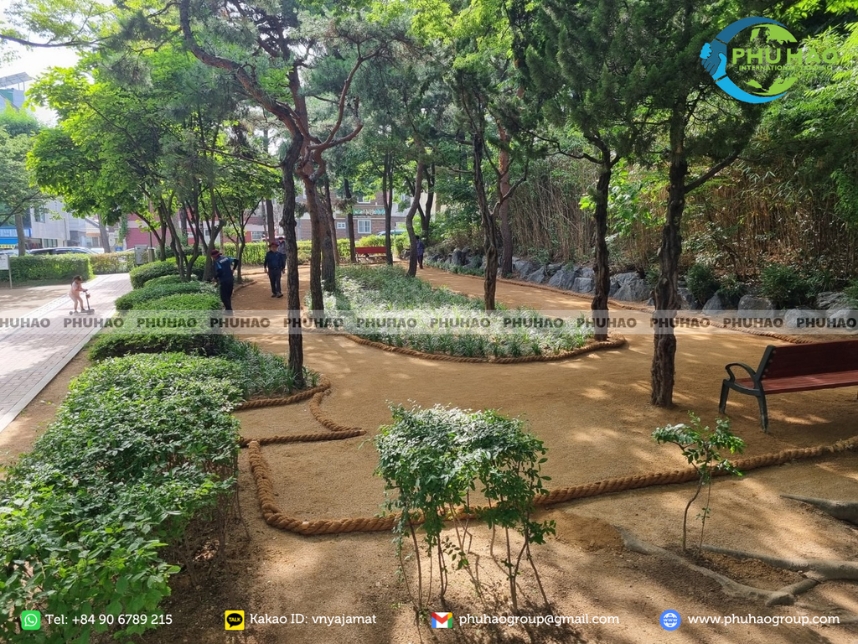
Close-up of coir rope spools spun from mature Ben Tre coconut husks with diameter tolerance under 5%, delivering superior tensile breaking strength for green initiatives
Under the factory quality release protocol at PHUHAOGROUP, engineers verify coir rope diameters using digital vernier calipers under a nominal 5N tensile tension load to eliminate natural fiber porosity. The technical matrix details production metrics aligned with international export shipping documentation:
| Diameter Spec (mm) | Standard Length (m) | Nominal Weight (kg/spool) | 40HC Container Packing Capacity |
| 10mm-12mm | 100-200m | 15.50 | 1,150 spools |
| 12mm-14mm | 100-200m | 16.40 | 1,100 spools |
| 14mm-16mm | 100-200m | 17.00 | 960 spools |
| 16mm-18mm | 100-200m | 18.50 | 880 spools |
| 18mm-20mm | 100-200m | 19.50 | 840 spools |
| 20mm-22mm | 100-200m | 21.50 | 760 spools |
| 80mm (Heavy Hawser) | 20m | 37.00 | 315 spools |
Spun by tightly twisting fine coir twine yarns together, the 10mm to 14mm diameter range creates specialized training systems for climbing crops within modern cultivation setups. This diameter bracket delivers balanced mechanical elasticity, allowing field crews to tie binding knots rapidly without cutting into live plant stems. The natural surface texture of coconut fiber encourages rapid root hold, phasing out synthetic plastic lines entirely.
The mid-range 14mm to 18mm sizing functions as the backbone for export cargo strapping and rustic landscape installations. Applying machine-twisted coir rope across these dimensions relies on the natural rough surface to generate strong friction against packaging walls, preventing shifting in transit. Resistance to elongation under static dead loads keeps bundles tightly tensioned across multi-week shipping routes.
For eco-friendly riverbank embankments, erosion control blankets, and marine slope anchoring, heavy 20mm to 80mm thick twisted cordage provides essential engineering durability. Concentric core multi-ply compression yields massive load distribution surfaces that absorb shearing forces from torrential runoffs and unstable hillside soil tension. This dense core maintains project stability for 3 to 5 years before biodegrading naturally into organic soil conditioner.
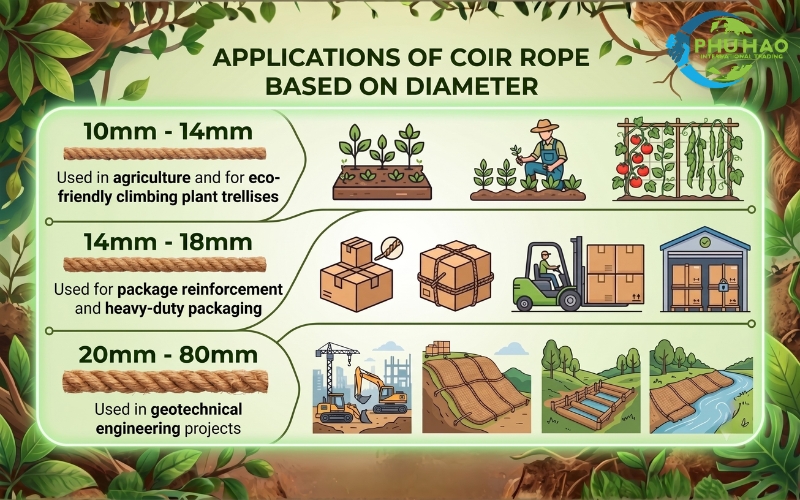
Application breakdown of coir rope by structural diameter categories
Tensile strength in finished coir rope depends directly on factory mechanical processing rather than raw fiber mass alone. Specifiers must scrutinize two mechanical criteria during laboratory sample analysis: strand geometry and axial compression twist pitch.
Industrial twisting configurations divide into 2-ply and 3-to-4-ply builds. A 2-ply layout offers an economical option, looser winding pitches, and minimal bulk weight, making it suited for basic crop trellising. In contrast, 3-ply and 4-ply patterns distribute axial stress symmetrically across the rope core, preventing unwanted rotational untwisting while under suspended overhead loads.
The turns per running meter, designated as the coir fiber twist degree, controls the tensile deformation modulus prior to failure. Insufficient twist turns cause shorter fiber segments to slip out of bundles under low tensile tension, causing early line breakage. Conversely, excessive mechanical twisting introduces severe internal residual shear stress, turning the fibers brittle and restricting flexural compliance. A calibrated mechanical run locks the twist pitch between 45 and 55 turns per meter for small-gauge cordage, allowing the coir rope to absorb sudden dynamic shocks without ply delamination.
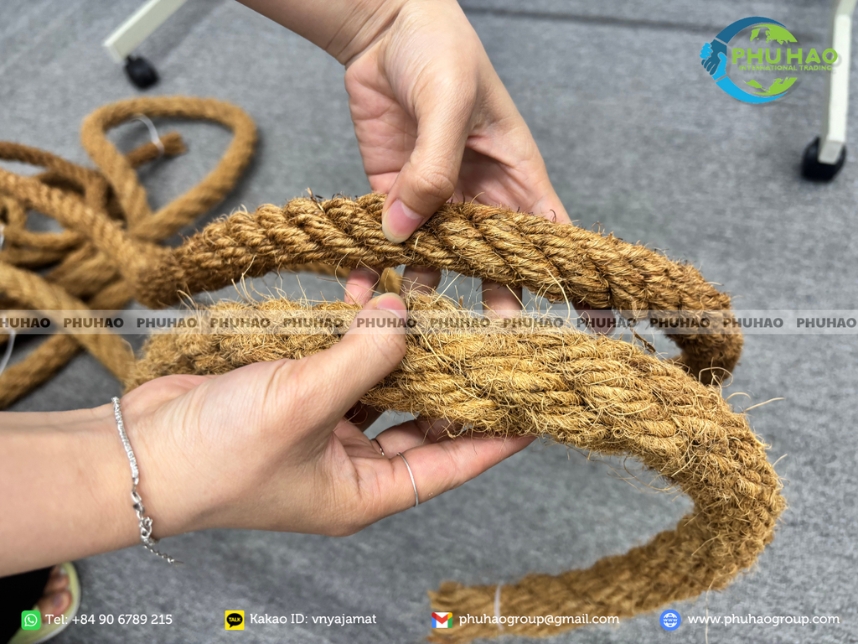
Load-bearing performance of coir rope depends on fiber volume and mechanical yarn fabrication methods
Raw agro-fiber products entering global ports face rigid technical checks governing moisture control and biological residues. PHUHAOGROUP executes an enclosed conditioning protocol on processed coconut husks to eradicate long-haul maritime shipping risks.
Excess internal moisture serves as the primary catalyst for mildew expansion and tensile fatigue in finished coir rope. Whenever fiber moisture climbs over 18%, internal heat generation inside sealed container environments activates anaerobic bacteria that break down natural cellulose chains. Export compliance specifies regulated thermal drying that sets final moisture content strictly between 12% and 15% prior to spooling and strap banding.
Following open-air sun dehydration, raw fiber enters rotary screen tumbling units that scrub out residual coir pith dust and dirt particles. Processing guidelines enforce strict purity tolerances, capping residual dust and broken fibers below 2% before spinning commences. Stripping away loose pith fragments creates smooth, uniform contact friction between individual strands, eliminating yarn drift or structural micro-notches that could snap under heavy loads. When installed within modern greenhouse farming facilities, this clean cordage produces zero loose organic dust drift, preserving clean ventilation and removing potential nesting habitats for agricultural pests.
>>> WATCH MORE: WHAT IS COIR ROPE? LET’S DISCOVER THE PRODUCT DETAILS
Optimizing container space while maintaining fiber integrity across ocean freight transit is fundamental for commercial operations. Shipping hygroscopic agricultural products overseas demands deep knowledge of cargo stowage and plant quarantine clearances.
Coconut fiber possesses a light specific density combined with bulky volumetric mass, driving up freight rates per metric ton if left uncompressed. For professional coir rope production lines, tight concentric spool winding matched with high-tensile polypropylene strapping removes air pockets between wound layers. This strapping method allows factories to load 800 to 1,150 export-size coils into an individual 40-foot High Cube (40HQ) maritime container, reducing overseas transport expenses by up to 20%.
All agricultural cargo imported into markets across the European Union, the United States, Japan, or South Korea must clear strict biosafety screening. Applying approved Methyl Bromide fumigation treatments eradicates insect egg deposits, beetle larvae, and active mold spores, neutralizing cargo loss hazards at sea. Shipments leave the processing mill accompanied by valid Phytosanitary Certificates and standard international Fumigation Certificates to ensure swift import border clearance.
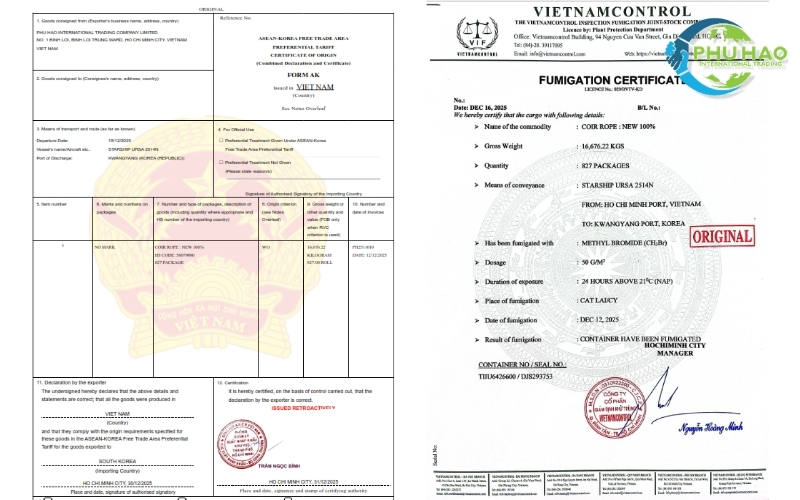
Phytosanitary certification and HT treatment papers for PHUHAOGROUP coir rope consignments delivered to South Korea
How long does coir rope endure open-air weathering?
It maintains functional field life for 3 to 5 years, depending on local ambient humidity, UV exposure, and selected diameter thickness.
Why replace nylon or polypropylene strapping with coir rope in commercial agriculture?
The material biodegrades organically, amends underlying soil texture, and leaves zero microplastic residues in farm plots.
How should warehouses store coir rope bundles to avoid rot and mildew?
Store inventory packages in raised, dry storage zones sheltered from direct rain or sunlight, keeping warehouse bays continuously ventilated.
Standardizing diameter tolerances and calculating true safe working capacities remain the twin cornerstones of field operational efficiency. Operating high-capacity manufacturing centers in Ben Tre’s primary coconut district along with mechanized processing setups, PHUHAOGROUP delivers premium export-grade coir rope to international markets. Every outgoing lot undergoes rigorous evaluation covering fiber moisture limits, purity indexes, and pitch consistency to support our global commercial partners. Specifying industrial-grade coir rope lowers overall project expenditure while upholding environmental stewardship across your operations. Connect with our customer service department via Hotline: +84 906 789 215 or visit phuhaogroup.com to secure technical data sheets and ocean freight logistics solutions.
Contact us for a detailed FOB & CNF quotation:
PHU HAO INTERNATIONAL TRADING CO., LTD (PHUHAOGROUP)
📞 Tel/WhatsApp/WeChat/Zalo: +84 906 789 215
📧 Email: phuhaogroup@gmail.com / henry@phuhaogroup.com
🌐 Website: www.phuhaogroup.com
🏬 Alibaba: phuhaogroup.trustpass.alibaba.com
▶️ YouTube: @phuhaogroup
You have0products in your cart
There are no products in the cart.
Total order price