29 Sep, 2026
Coir logs exported to the Korean market demand rigorous control over physical engineering standards and marine container packing practices. South Korea features steep mountainous terrain intertwined with dense river and stream networks, leading ecological landscape contractors to establish strict requirements for natural revetment materials. Clearing customs smoothly at Busan or Incheon ports requires manufacturers to source clean coir fibers from Ben Tre, calculate fiber compression ratios, handle packing tolerances, and complete international phytosanitary protocols.
Coir logs exported to the Korean market must meet core compression densities of 125 to 160 kg/m³, quarantine moisture levels below 18%, and low electrical conductivity (EC) ratings. The rolls require exact mechanical tolerances, high-tensile outer wrapping, and official phytosanitary certification adhering to international regulations.
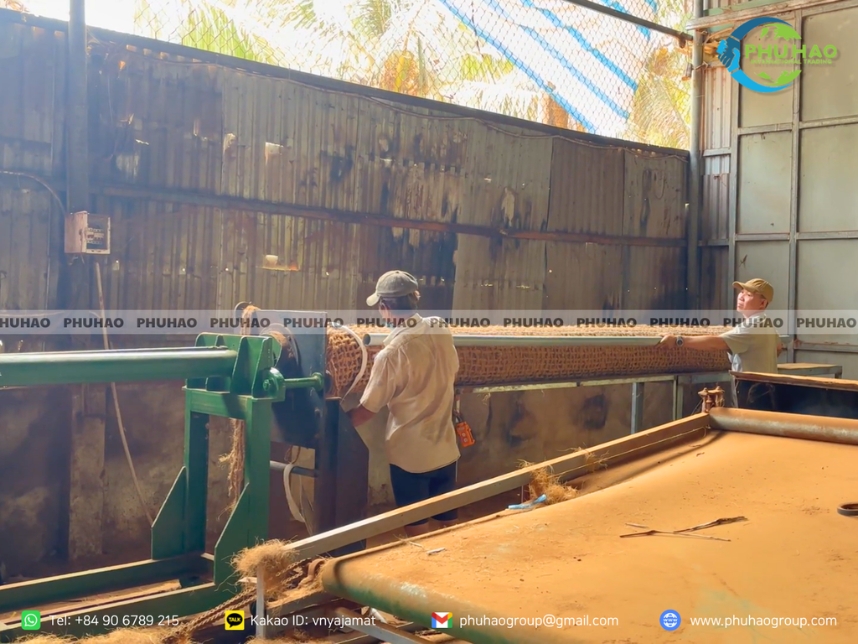
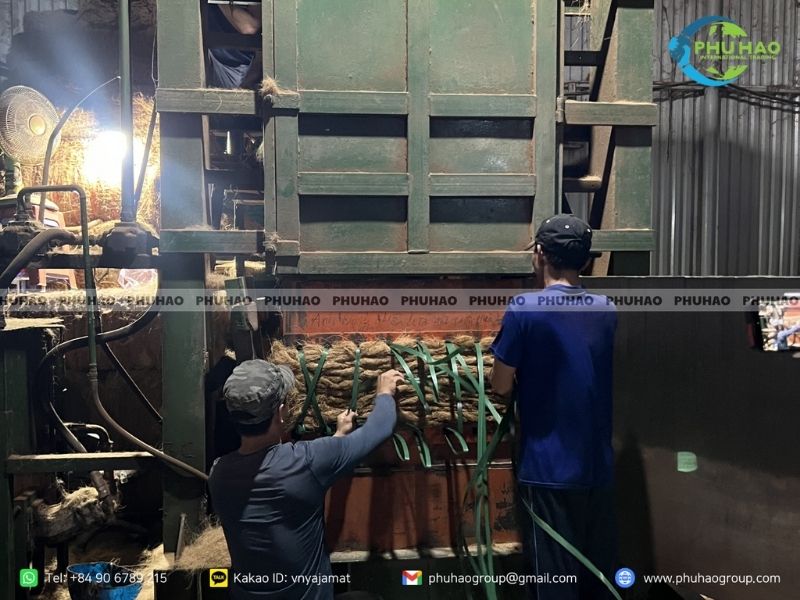
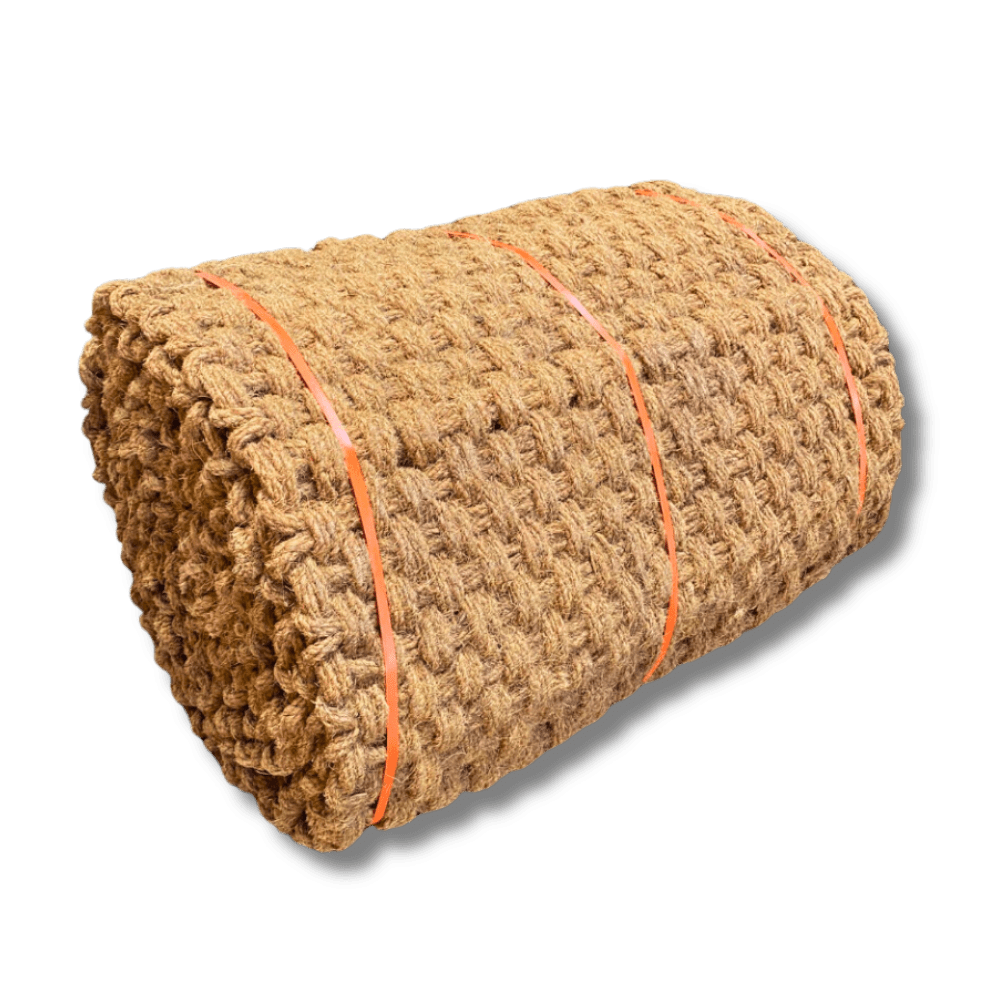
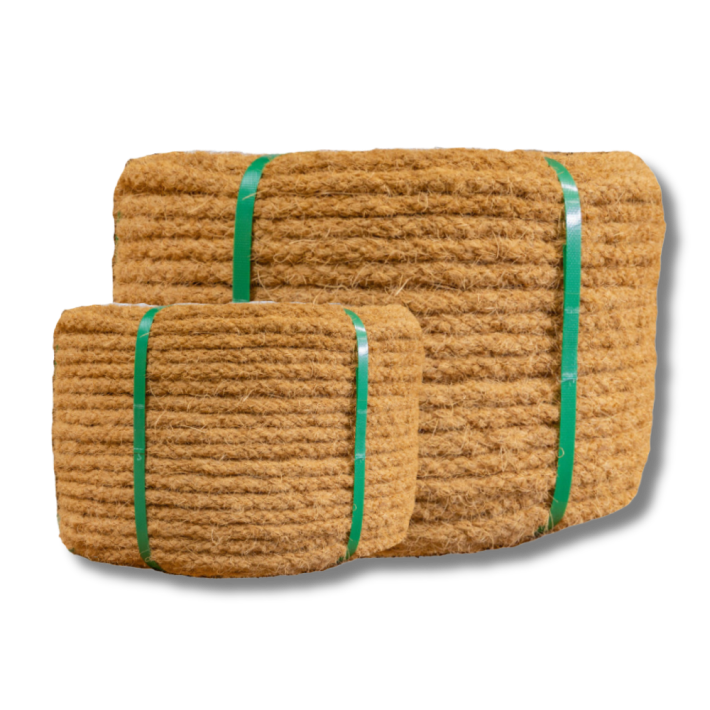
Tube-forming process for coir logs exported to the Korean market at the PHUHAOGROUP factory; call +84 90 6789 215 for technical support
Korean buyers categorize products into distinct specification groups to handle diverse flow terrains, from natural stream embankments to vertical slopes. Accurate geometric dimensions allow site crews to install tight joints, stopping soil erosion beneath revetment foundations.
Nominal diameters for standard bio-tubes range from 30 cm to 35 cm. While 2 m and 4 m lengths maximize container loading efficiency, PHUHAOGROUP supplies custom runs in standard lengths of 3 m and 6 m to match slope stabilization blueprints across South Korea. We maintain length tolerances within precise thresholds to eliminate field gaps during installation.
The outer casing protects the inner core against water shear forces. Depending on project specifications, the plant uses a biodegradable coir netting outer woven from natural coir yarn. Inside, 100% aged Ben Tre coir fiber maintains a density of 125 to 160 kg/m³ in compliance with ASTM D6525 guidelines, delivering strong bending strength and structural firmness.
As raw plant material, shipments must clear inspection by the Animal and Plant Quarantine Agency (APQA) of South Korea. Discrepancies in moisture content or foreign biological residue risk port re-export orders and demurrage fees.
Shipment moisture must stay below 15% to 18%. Controlling moisture halts condensation inside closed containers, suppressing mold and anaerobic microbial spores. Prior to container sealing, technicians perform mandatory fumigation using methyl bromide or heat treatment under ISPM 15 guidelines. An authentic Phytosanitary Certificate must accompany the bill of lading for customs clearance.
Raw Ben Tre coir fiber undergoes washing in fresh water to eliminate natural tannins and brackish water salt residue. Electrical conductivity (EC) remains within safe bounds to avoid altering local water salinity along shoreline job sites. Workers screen the raw material to remove shell fragments, gravel, and debris before hydraulic tube compression begins.
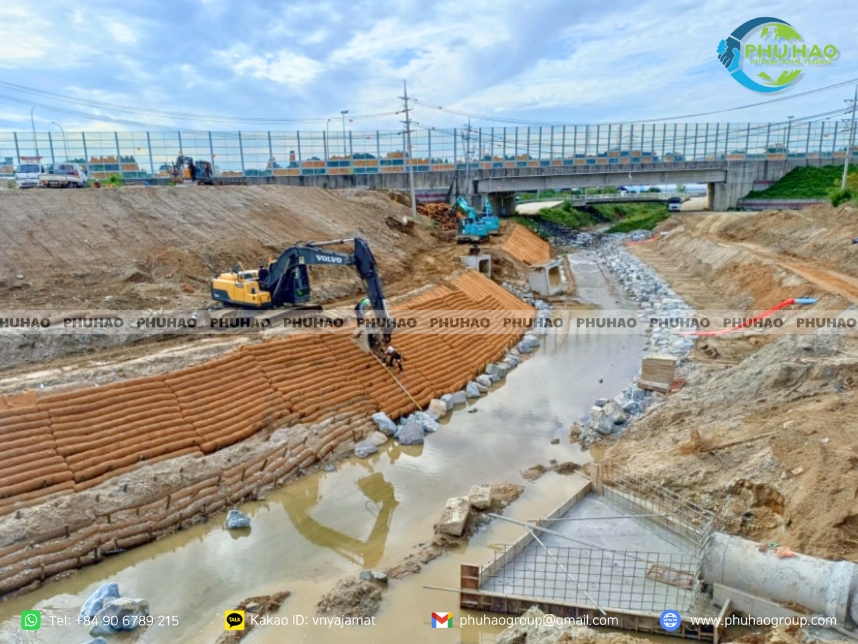
Coir logs exported to the Korean market undergo strict quality inspection to protect local ecosystems
Ocean freight accounts for a substantial share of landed unit costs. Applying engineered loading patterns inside high-cube containers cuts shipping costs per linear meter.
Coir logs exhibit natural elasticity. When calculating loads for a 40HC cont, logistics planners calculate the dead space formed between rounded surfaces rather than using raw cubic meters. A standard 40-foot High Cube container provides roughly 76 m³ of volume with an internal door height of 2.69 m. When loading 35 cm diameter, 4 m long tubes, maximum capacity reaches 180 rolls. Through uniform hydraulic mold compression, PHUHAOGROUP caps diameter deviations within 10%, minimizing void volume.
| Tube Specifications (Diameter x Length) | Standard Unit Weight | 20DC Container Capacity | 40HC Container Capacity | Technical Tolerance |
| 30–35 cm x 2 m | 17–21 kg/tube | 160 tubes | 360 tubes | Within ±10% |
| 30–35 cm x 4 m | 35–38 kg/tube | 80 tubes | 180 tubes | Within ±10% |
Logistics crews stack cargo in a staggered honeycomb pattern instead of vertical rows. Bottom layers nest and support upper tiers, distributing weight across the trailer floor and preventing shifting during transit.
>>> READ MORE: Coir Log Installation Procedure For Canal And Riverbank Revetment: 5-Step Geotechnical Installation For Sustainable Erosion Control
Why do Korean civil contractors select coconut fiber coir logs over sandbags or gabions?
Natural fiber bio-logs decompose into nutrient-rich humus over time, leaving zero solid waste while supporting native vegetation.
What standard coir log dimensions go to the Korean market?
Most projects order 30 cm to 35 cm diameters in 2 m or 4 m lengths to match container transport limits.
How do you prevent coir logs from flattening after long-distance ocean transit?
Combining high-tonnage hydraulic compression with resilient outer mesh netting allows the tubes to hold their circular cross-section after unpacking.
Do natural fiber casing nets require methyl bromide fumigation before entering South Korea?
South Korean border control requires complete phytosanitary treatment and official quarantine certificates for plant-based casings.
Bio-engineered revetments made from agricultural by-products represent a growing design standard across South Korea. Decomposing into rich organic humus over a 3-to-5-year life cycle, every roll of coir logs exported to the Korean market controls embankment erosion while providing root anchors for endemic riverbank flora. Replacing rigid concrete blocks and wire mesh with soft coir revetments protects local watersheds. Sourcing coir logs exported to the Korean market from PHUHAOGROUP gives contractors dependable mechanical bank stabilization and verified ecological performance.
Contact us for a detailed FOB & CNF quotation:
PHU HAO INTERNATIONAL TRADING CO., LTD (PHUHAOGROUP)
📞 Tel/WhatsApp/WeChat/Zalo: +84 906 789 215
📧 Email: phuhaogroup@gmail.com / henry@phuhaogroup.com
🌐 Website: www.phuhaogroup.com
🏬 Alibaba: phuhaogroup.trustpass.alibaba.com
▶️ YouTube: @phuhaogroup
You have0products in your cart
There are no products in the cart.
Total order price