04 Sep, 2026
The coir mat weaving technique using automatic machinery plays a vital role in manufacturing eco-friendly export materials from Ben Tre agricultural by-products. Applying high-precision mechanization controls mesh tolerance and maintains exceptional tensile strength for every linear meter of finished matting. The modern production line at PHUHAOGROUP eliminates standard technical errors inherent to traditional methods, delivering robust structures for erosion control and slope greening. Strict engineering standards govern every stage to satisfy strict international quality barriers in markets like South Korea, Japan, and Europe.
The coir mat weaving technique using automated machines is a mechanized manufacturing method designed to shape eco-friendly mats from natural coir rope. It integrates multi-axis feeding systems with programmed automatic pressing and weaving mechanisms. This ensures superior tensile strength and precise mesh density for international landscaping and civil projects.
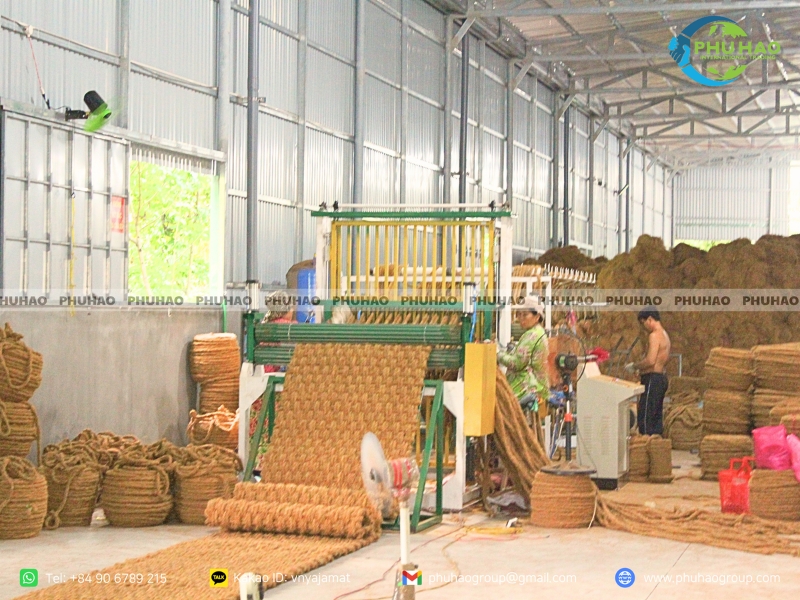
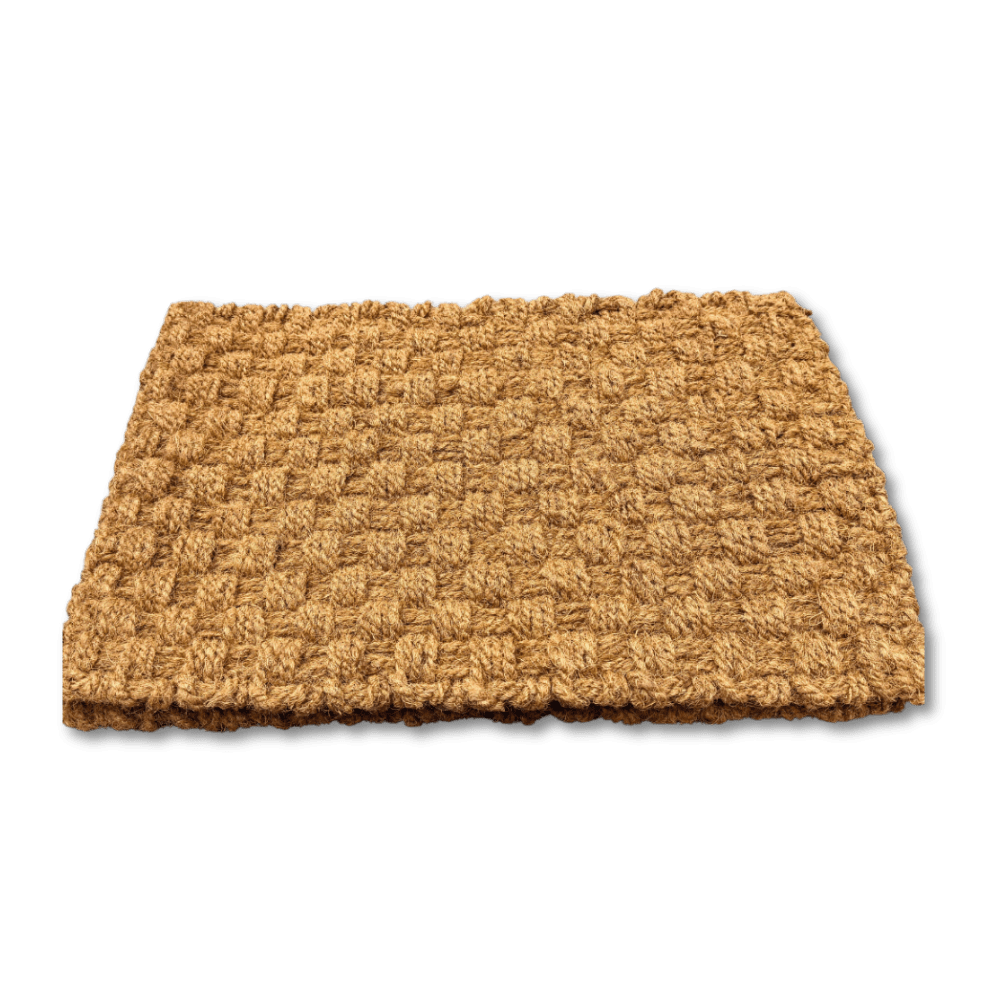
Continuous industrial weaving line operating with 100% mature Ben Tre coconut fiber
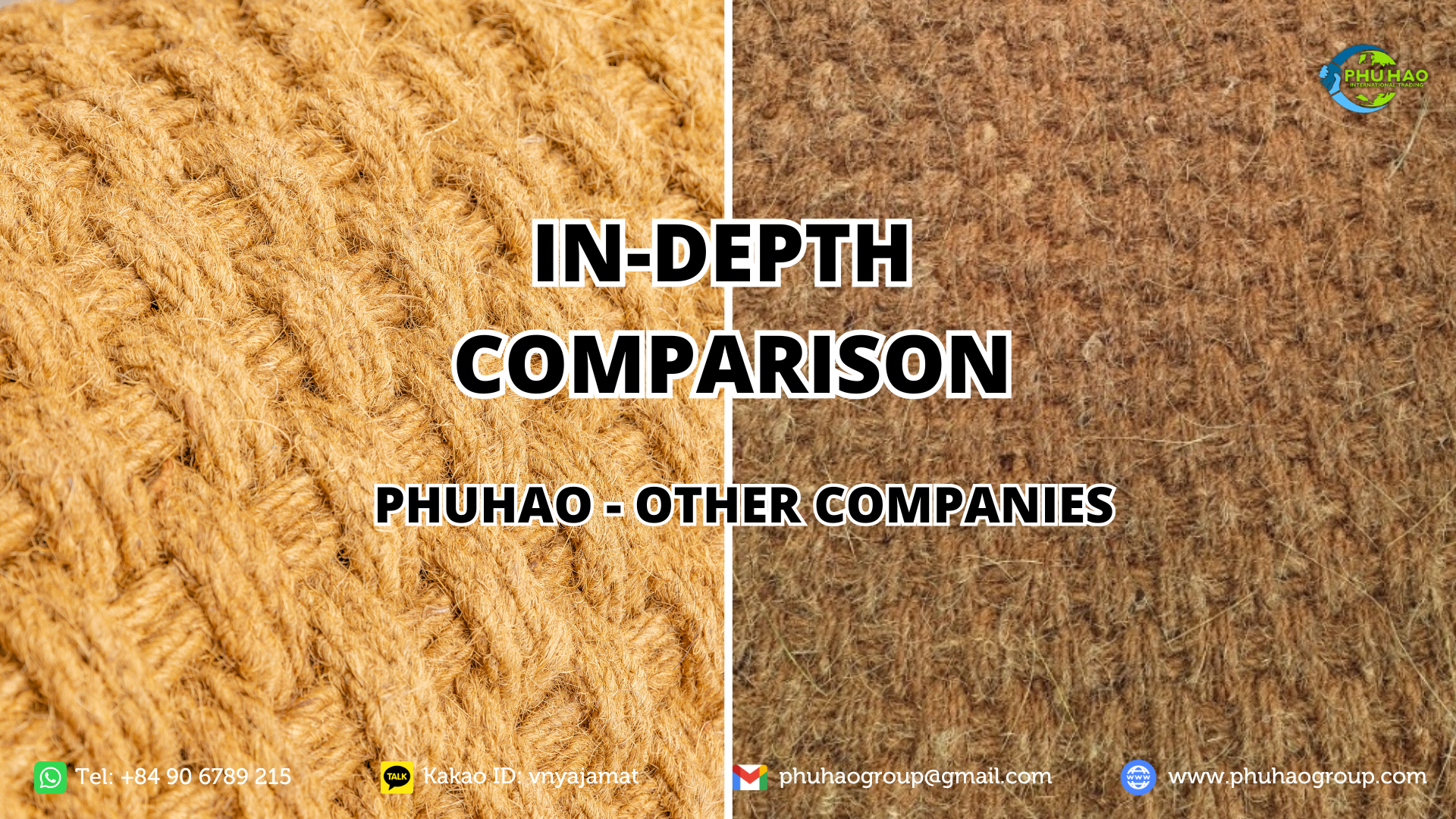
In industrial manufacturing, applying the coir mat weaving technique with automated machines ensures high mesh density precision, a critical index determining physical properties and field lifespan. By utilizing this coir mat weaving technique, defects such as slack sections or uneven mesh spacing disappear. Unlike a hand-woven coir mat that depends on individual manual strength and variable craftsmanship, the mechanical weaving system maintains uniform technical specifications across rolls spanning hundreds of meters.
The automated coir mat weaving machine utilizes mechanical pressure rollers and electronic positioning shafts to maintain uniform tension across all warp and weft ropes. Each mechanical stroke securely binds the mat body to the coir mat edge, preventing distortion, loose strands, or joint separation under harsh outdoor forces. Consequently, this coir mat weaving technique creates dense mat surfaces, optimizing soil moisture retention and promoting sustainable vegetation growth.
Tensile strength limits and elongation under load serve as strict quality benchmarks for export goods. With the automated coir mat weaving technique, spacing between weft passes remains consistent with a low tolerance of only -1mm to +2mm (plus or minus 1-2mm tolerance). Due to the tight interlacing structure, the mat delivers uniform tensile resistance across its entire cross-section, eliminating mechanical sagging and reducing direct friction against the underlying subgrade.
Production in industrial plants requires synchronized operations from raw material screening to each weaving machine cycle. Standardizing each phase enables the coir mat weaving technique to achieve peak operational efficiency without producing defective material.
| Step | Processing Phase | Detailed Technical Specifications |
| Phase 1 | Raw Material Sourcing | Collect mature Ben Tre coconut husks, extract raw fiber, and naturally sun-dry. |
| Phase 2 | Refined Pre-processing | Mechanically open and comb fibers, thoroughly screening out coco peat and fine residues. |
| Phase 3 | Rope Twisting & Shaping | Spin fine coir strands and ply them into round, standardized coir ropes. |
| Phase 4 | Automatic Mechanical Weaving | Insert raw material into continuous loom frames that are equipped with automatic stop-motion sensors. |
| Phase 5 | Finishing & Export Dispatch | Inspect joints (QC/QA), apply surface heat treatment, and then roll them under compression. |
The quality of raw material is determined by how smoothly fibers pass through mechanical loom eyes. PHUHAOGROUP selects only properly matured Ben Tre coconut husks to ensure optimal levels of lignin and cellulose. After extraction, dried fibers reach a standard moisture content of 15% to 20% before being processed through opening machines, which remove dust, coco peat, and impurities. Technicians twist the refined fibers into dual-core ropes of precise diameter, ready for feeding into dedicated coir mat weaving equipment.
During the weaving cycle, knitting needles and shuttle mechanisms operate in sync. One of the main advantages of our coir mat weaving technique is integrating optical sensors or mechanical contact switches. These devices immediately stop the drive motor when a broken warp or weft rope is detected. This intelligent mechanism enables operators to splice ropes quickly, preventing missing stitches or structural gaps in the mat. As a result, we ensure 100% consistency across all finished batches.
>>> WATCH MORE: Production Process at PHUHAOGROUP Factory
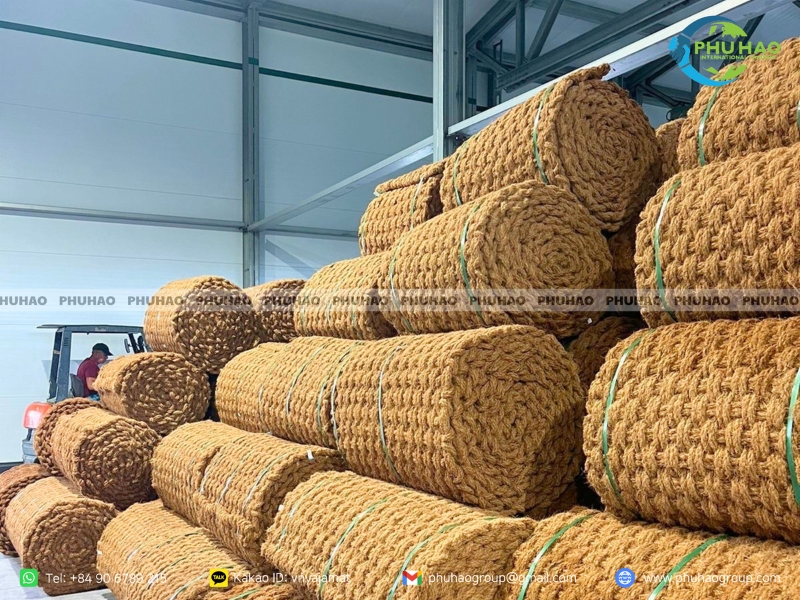
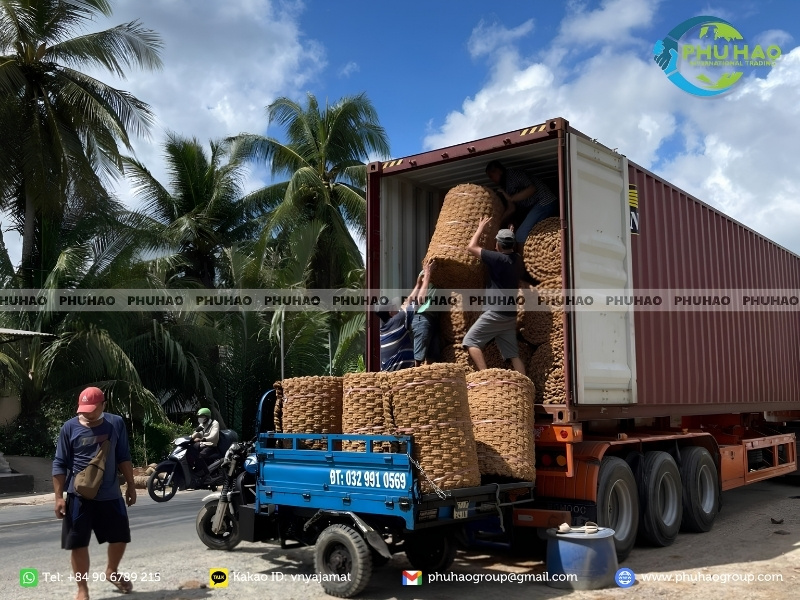
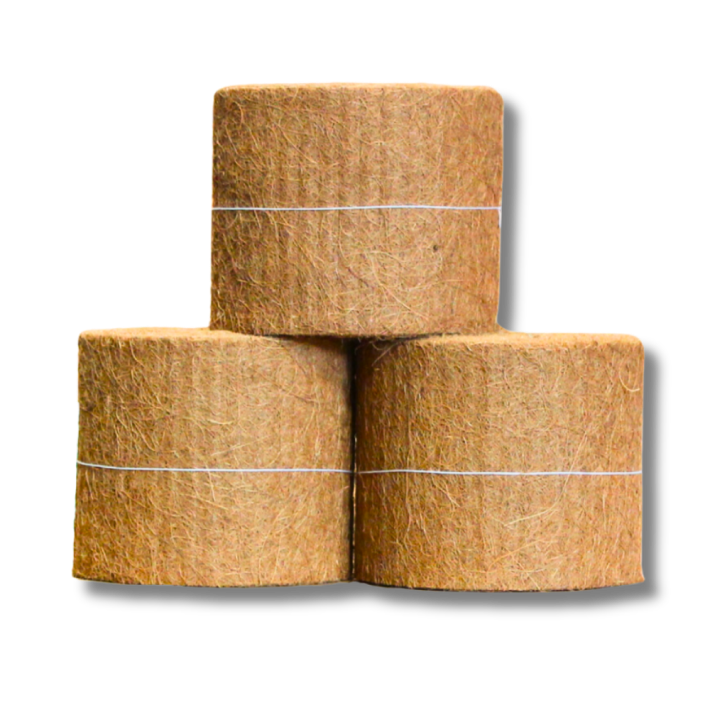
Finished 35mm rolled coir mats packaged for export to South Korea in 40HC container standards
Global infrastructure and landscaping projects across South Korea, Japan, and Western nations demand large volumes and tight delivery schedules. The coir mat weaving technique meets these demands reliably. Comprehensive implementation of the coir mat weaving technique scales production volume rapidly, resolving raw supply constraints tied to manual handcrafting.
Factory machinery operates across 3 continuous shifts daily without losing mechanical precision. Running the coir mat weaving technique on industrial looms yields speeds many times faster than skilled artisans. The stability of this machine-driven coir mat weaving technique enables PHUHAOGROUP to optimize production costs, lower unit prices, and maintain stable output regardless of seasonal labor availability.
Operating large-scale manufacturing workshops in the heart of Ben Tre’s raw material belt, the company sustains an export supply capacity of 20 to 40 40HC containers monthly. Supported by the automated coir mat weaving technique, the company efficiently processes large-volume orders with diverse specifications, ranging from widths of 0.6 meters to 2.0 meters and a thickness of 35 millimeters. These products are compressed and dispatched promptly via Cat Lai Port.
>>> READ MORE: Causes Of Incorrect Coir Mat Dimensions After Unrolling And Permissible Tolerance Rates
How does an automatic coir mat weaving machine operate?
The loom uses a mechanical transmission shaft system paired with synchronized weaving arms and compression rollers to interlace coir ropes continuously.
What specifications and thicknesses are available for machine-woven coir mats?
Mats feature widths from 0.6m to 2.0m, lengths from 5m to 10m, and an export standard thickness of 35mm.
Do machine-woven coir mats meet export standards for tensile strength?
Yes, the mats provide high tensile strength and tightly locked structures, fully complying with testing criteria in South Korea and Japan.
What are the quality control criteria for input coir ropes?
Ropes must use mature Ben Tre coir fibers, maintain moisture below 20%, stay free of dust and peat, and exhibit uniform twisting.
How does mesh density tolerance affect mat durability and surface stability?
Low mesh density tolerance guarantees a uniform surface and tightly locked structure. This design evenly distributes foot traffic loads, stops rope shifting, and protects the underlying subgrade from deformation under heavy transit on slopes.
Standardizing output quality through the coir mat weaving technique elevates the value of Vietnamese agricultural by-products worldwide. PHUHAOGROUP upgrades automated weaving systems to deliver eco-friendly coir mats tailored for global landscaping and soil conservation projects. Mastering the coir mat weaving technique stands as our firm commitment to steady delivery timelines, 20 to 40 containers monthly output, and export-grade reliability.
Contact us for a detailed FOB & CNF quotation:
PHU HAO INTERNATIONAL TRADING CO., LTD (PHUHAOGROUP)
📞 Tel/WhatsApp/WeChat/Zalo: +84 906 789 215
📧 Email: phuhaogroup@gmail.com / henry@phuhaogroup.com
🌐 Website: www.phuhaogroup.com
🏬 Alibaba: phuhaogroup.trustpass.alibaba.com
▶️ YouTube: @phuhaogroup
You have0products in your cart
There are no products in the cart.
Total order price