15 Sep, 2026
Coir net vs geotextile represents a decisive engineering comparison in transportation infrastructure and cut-slope stabilization. In markets with strict ecological benchmarks such as South Korea, selecting surface erosion control measures involves far more than tensile strength values; it directly dictates how fast native ecosystems regenerate. The direct comparison between coir net vs geotextile highlights a clear shift in engineering mindset from rigid, forced stabilization to sustainable ecological restoration that secures long-term slope integrity.
Coir net vs geotextile defines the functional boundary between biological surface reinforcement and synthetic barriers. Open-mesh structures woven from natural fibers perform alongside high-tensile woven or non-woven polymer fabrics. This design stabilizes microclimatic moisture levels while establishing self-sustaining ecological ground cover on steep embankment slopes.
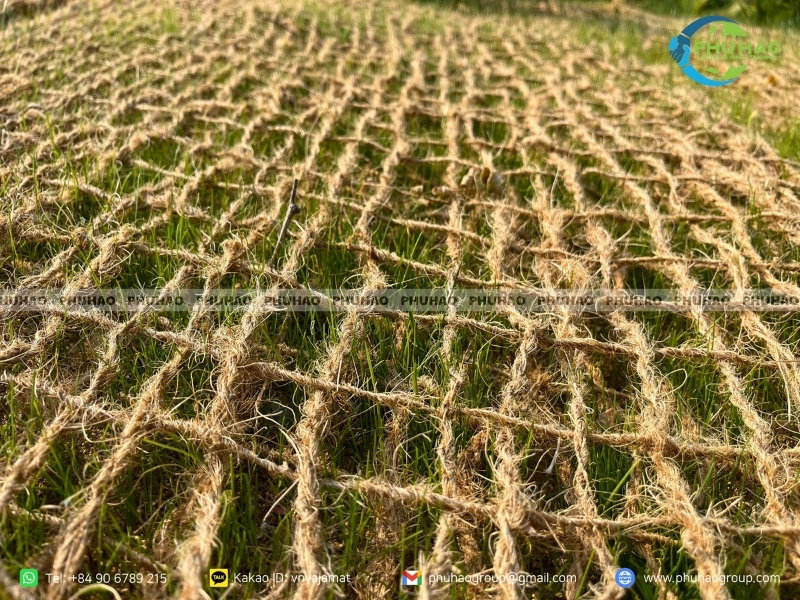
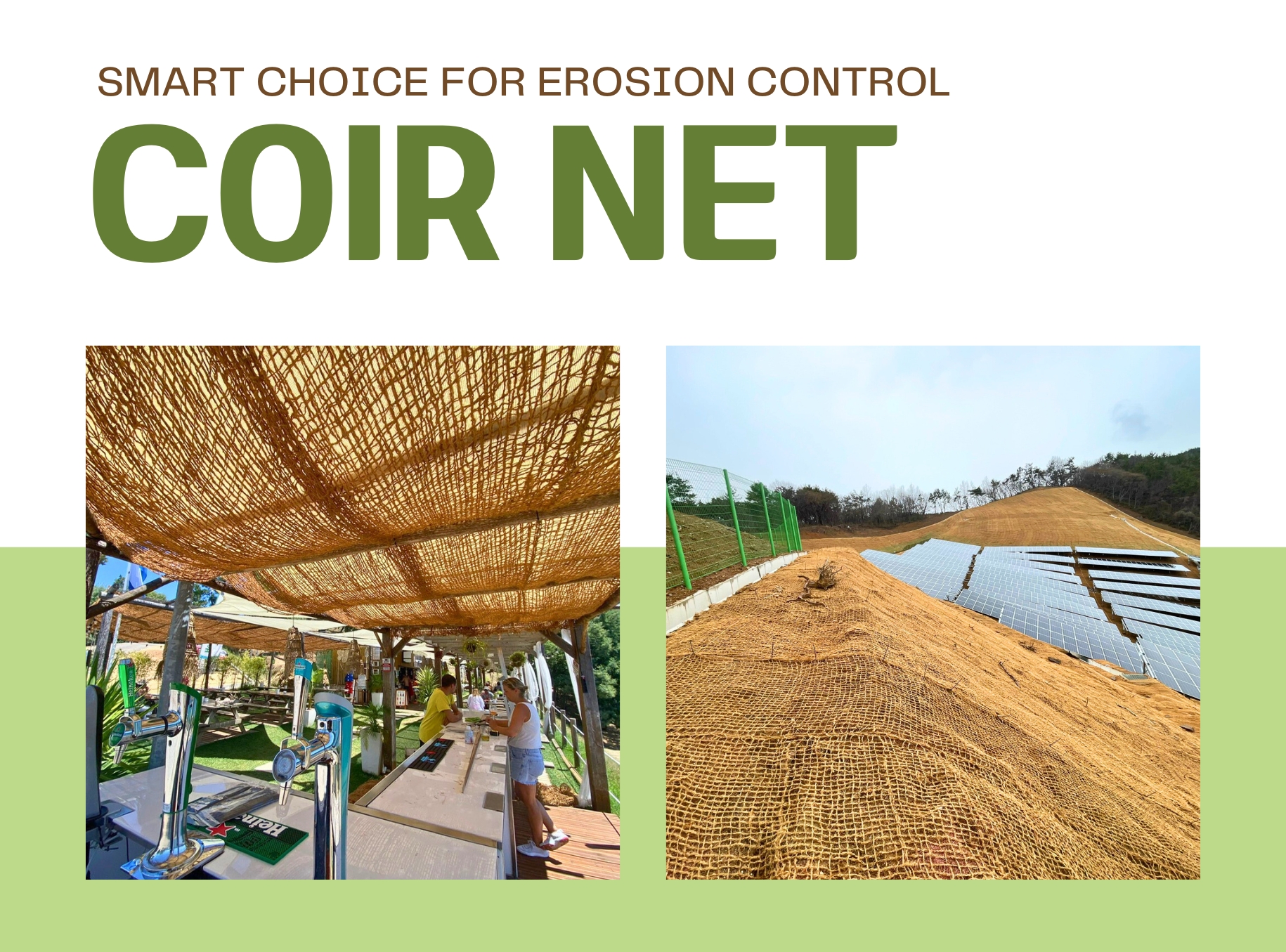
Field inspections confirm the superior moisture retention of coir net vs geotextile during slope stabilization for green revegetation projects
From a slope geotechnical perspective, permanent structural stability relies on the anchoring action of native root networks. When engineers compare coir net vs geotextile, internal fiber architecture directly determines greening rates.
Woven entirely from raw coconut fibers, coir net exhibits high porosity that maintains steady microclimatic moisture for seed germination. Operating as a biodegradable eco-friendly material, this woven mesh decomposes naturally over 3 to 5 years, enriching the soil bed with nutrient-dense organic humus. In comparative measurements of coir net vs geotextile, this organic fiber layer acts as a thermal buffer that shields young shoots from intense solar radiation.
In contrast, synthetic PP/PE geotextile forms an impermeable, light-blocking sheet that stops topsoil gas exchange. Field trials comparing coir net vs geotextile show that synthetic sheets absorb high thermal loads, searing tender root tips. The dense synthetic membrane also traps emerging shoots and prevents taproots from penetrating deep subsoil strata.
Under intense ultraviolet site exposure, engineers evaluate structural integrity using the empirical benchmark data for coir net vs geotextile below:
| Technical Specification | Natural Coir Net | Synthetic Geotextile (PP/PE) |
| Tensile Strength | 7–18 kN/m (ideal for natural slope stabilization) | 15–50+ kN/m (resists high initial mechanical loads) |
| Elongation at Break | 15%–25% (flexible, contours tightly to micro-topography) | 10%–60% (varies by woven or non-woven format) |
| UV Resistance | Naturally durable with lignin content > 40% | Degrades steadily; embrittles without carbon black |
| Lifespan | 3–5 years (smoothly transfers load-bearing capacity to root systems) | Persists inertly or tears into fragmented plastic debris |
During severe downpours, surface hydraulics dictate toe sediment accumulation. The kinematic evaluation of coir net vs geotextile highlights how surface friction changes runoff behavior:
| Runoff Kinematics | Open-Mesh Coir Net | Solid Synthetic Geotextile |
| Runoff Velocity | Drops by 50%–70% via rough surface friction | Accelerates over slick planes, carving toe gullies |
| Piping and Underscour | Eliminated entirely through snug topsoil adhesion | Forms water pockets that scour subgrade voids under the sheet |
| Fine Particle & Seed Retention | Mesh openings act as microscopic silt traps | Seeds wash down smooth skins or choke within synthetic pores |
| Hydrostatic Equilibrium | Multidirectional free drainage avoids pore-gas build-up | Restricts rapid drainage, prying anchoring pins loose |
Sound engineering requires matching technical feasibility with full lifecycle value. Site engineers assess coir net vs geotextile against localized geological realities and slope scale.
Stabilization selections depend on landslide risk thresholds, seepage vectors, and targets for a functional green landscape. The criteria below specify field selection between coir net vs geotextile:
| Geotechnical Conditions | Prefer Coir Net | Prefer Geotextile |
| Slope Gradient | Moderate to gentle slopes (1:1 to 1:1.5; slope angle <= 45 degrees) | Steep, vertical cuts (> 45 degrees to 70 degrees) demanding deep tensile reinforcement |
| Lithology & Soil Profiles | Sandy clay, loam, and gravelly slopes targeted for revegetation | Loose sands, weak silts (piping control), or chemically aggressive soils |
| Precipitation & Runoff | Dispersed overland runoff, seasonal rainfall < 2,500 mm/year | High-velocity channel flow (velocity > 3 m/s), concentrated toe swales |
| Engineering Objectives | Restoring native flora, naturally enriching soils over 3–5 years | Mechanical separation, impermeable barriers, or subgrade filtration |
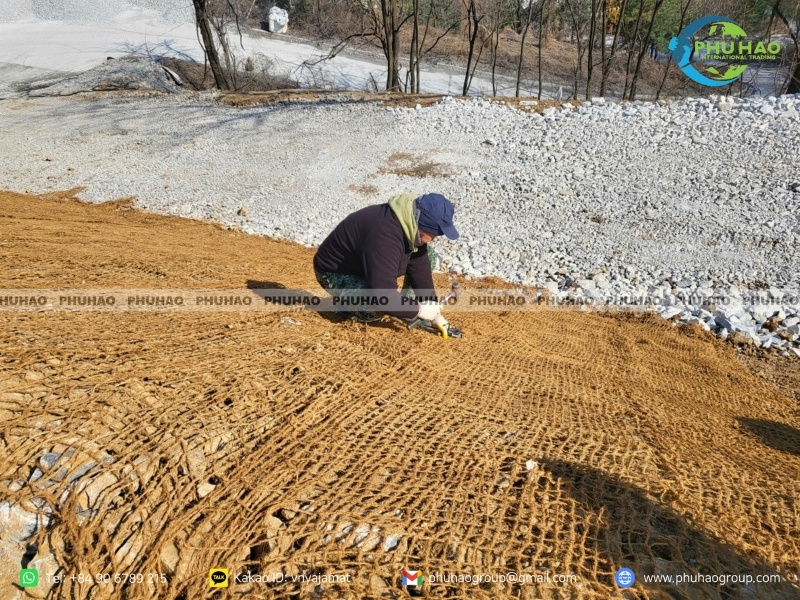
Direct anchoring of coir net onto an engineered slope face during field operations
The economic and ecological tradeoffs between coir net vs geotextile break down as follows:
| Lifecycle Index (LCC) & Ecology | Eco-Protective Coir Net | Synthetic Polymer Geotextile |
| Removal & Disposal Cost | Zero (degrades into organic matter that enriches soil) | High, requiring manual stripping and landfill fees |
| Microplastic Contamination | Zero chemical residue; safe for groundwater tables | Degrades into hazardous microplastics |
| Revegetation Maintenance | Cuts fertilizer and watering costs by 40% after two years | Incurs high reseeding costs because seeds fail to root naturally |
| Engineering Sustainability | Grows stronger as root networks mature | Weakens steadily as synthetic polymers degrade |
>>> READ MORE: Coir Net Export Price List 2026: Specifications From 200GSM To 700GSM By Container
Coir net vs geotextile: which retains moisture and stimulates grass roots more effectively?
Coir net regulates soil temperature, retains moisture, and accelerates root establishment far better than synthetic geotextile sheets.
Should steep sandy slopes use coir net or reinforced geotextile?
Steep sandy cuts require high-tensile reinforced geotextile for underlying structural support, covered with coir net to stop surface seed run-off.
How do engineers prevent synthetic geotextiles from trapping heat and scorching seeds?
Punch aeration holes across the sheet, topdress with straw mulch, or switch to natural plant-fiber netting to lower surface heat.
Should you combine non-woven geotextile underlayment with coir net for hydroseeding?
Avoid this combination. A non-woven sub-layer blocks roots from penetrating the base soil, shearing the new turf layer away.
Roadway slope protection requires balancing immediate mechanical stabilization with long-term ecological balance. Demanding infrastructure projects demonstrate the clear advantages of coir net vs geotextile for establishing permanent vegetative cover. Modern engineering looks beyond simple soil containment toward lasting ecological conservation, making coir net vs geotextile the definitive benchmark for sustainable civil construction.
Contact us for a detailed FOB & CNF quotation:
PHU HAO INTERNATIONAL TRADING CO., LTD (PHUHAOGROUP)
📞 Tel/WhatsApp/WeChat/Zalo: +84 906 789 215
📧 Email: phuhaogroup@gmail.com / henry@phuhaogroup.com
🌐 Website: www.phuhaogroup.com
🏬 Alibaba: phuhaogroup.trustpass.alibaba.com
▶️ YouTube: @phuhaogroup
You have0products in your cart
There are no products in the cart.
Total order price