14 Sep, 2026
Moldy coir net batches showing white patches after long ocean voyages remain a major concern for natural product exporters. Fiber discoloration triggers customer complaints and claims while damaging a supplier’s reputation in international markets. Monitoring drying operations closely, mitigating condensation inside sealed boxes, and shielding cargo from falling droplets protect shipments through delivery while preserving fiber tensile strength.
Moldy coir net growth inside shipping containers occurs when mold fungi multiply into white colonies or dark spots due to prolonged exposure to moisture. This process begins when residual moisture in the coir meets unventilated air, condensing into free-standing water droplets. Over time, this degradation weakens the fibers and damages the woven mesh surface.
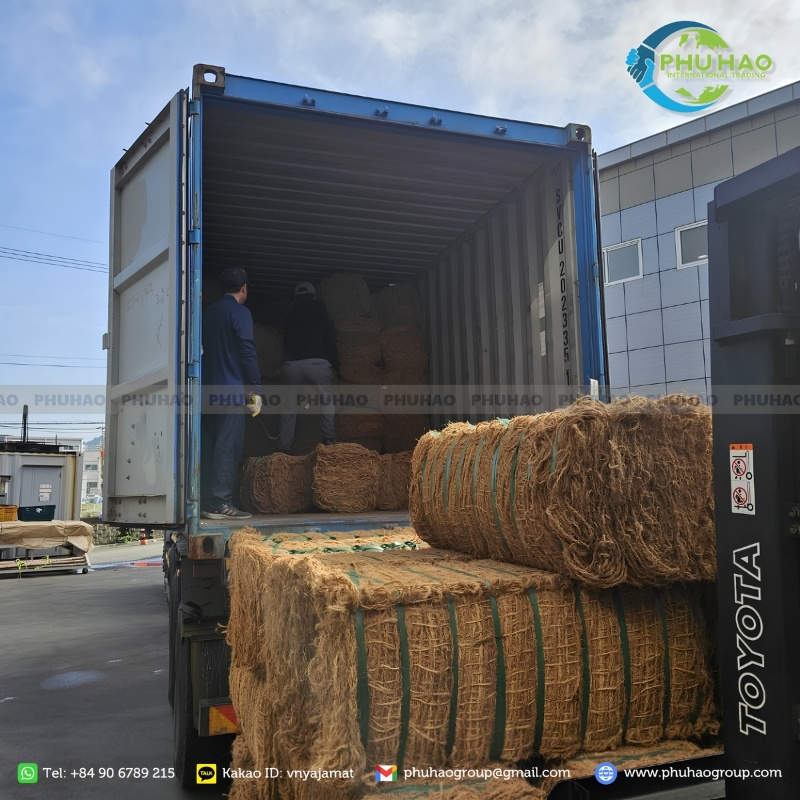
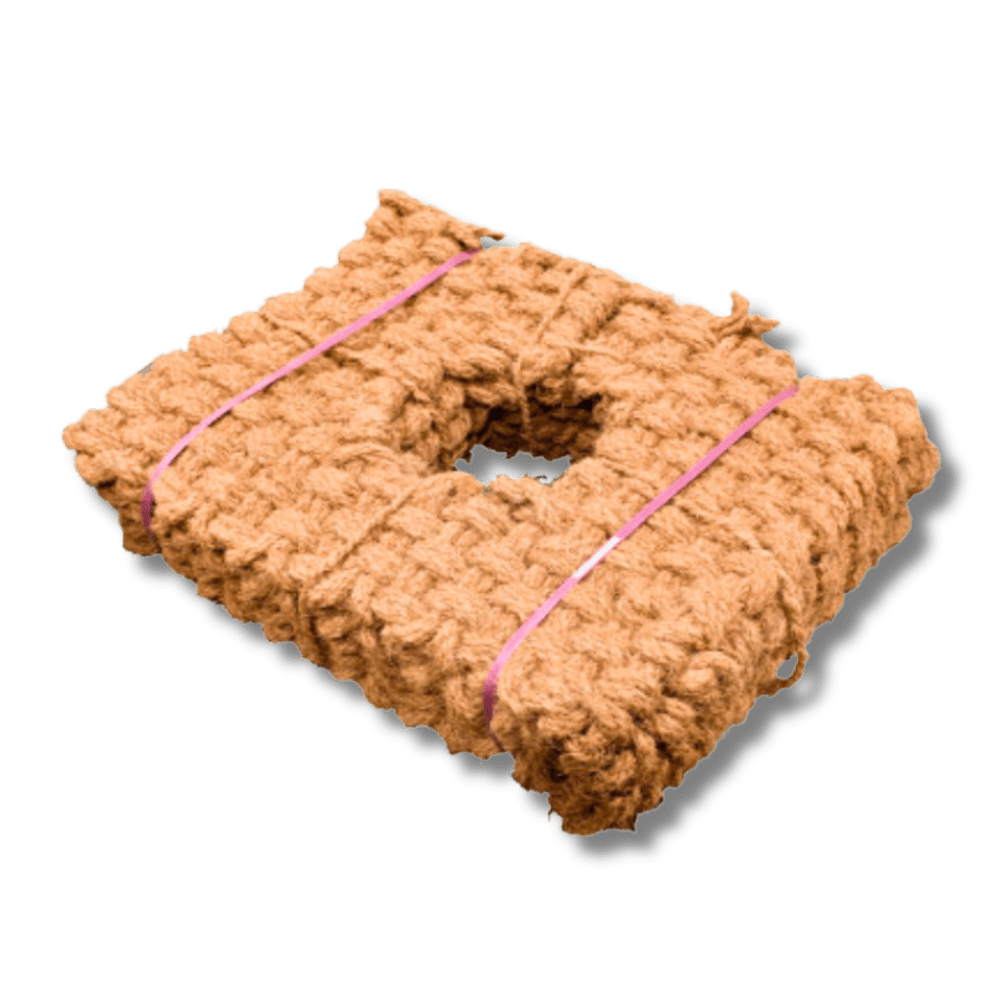
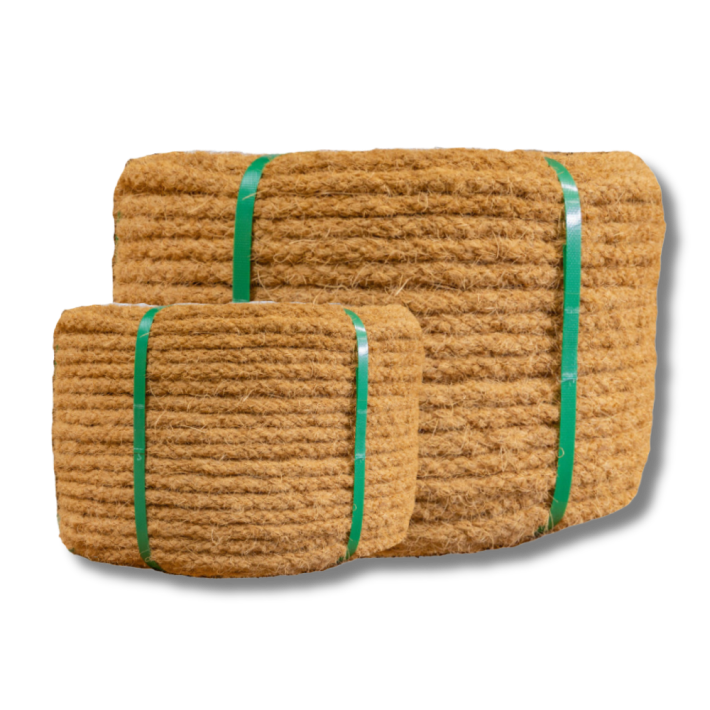
Coir net bales loaded tightly in a 40HC container to manage airflow and eliminate trapped moisture. Contact PHUHAOGROUP via hotline +84 90 6789 215 to optimize safe coir net export solutions
Preventing cargo deterioration requires understanding why fungi develop during ocean freight. When vessels cross marine routes with sharp temperature drops, internal container humidity shifts drastically. Without proactive safeguards, a moldy coir net issue rapidly spreads across whole stacks within days of departure.
Cargo moving from tropical, humid zones into cold-weather discharge ports frequently triggers container sweat. Cold ambient air drops the temperature of exterior steel walls and ceiling panels quickly while cargo retains core warmth and humidity. Moisture evaporating from coir rolls contacts cold ceilings, aggregates into heavy droplets, and falls directly onto lower tiers, leaving a patchy moldy coir net beneath.
Many processing facilities run surface moisture checks across roll edges but overlook deep core readings. Because coir net rolls are tightly bound, their inner cores hold heat and moisture longer after sun-drying or kiln cycles. High internal moisture feeds hidden fungal colonies that migrate outward toward the surface. This internal dampness explains why exporters discover a moldy coir net at destination even when rolls looked uniformly dry during loading.
Pre-weaving fiber dryness directly dictates mold resistance throughout the entire batch. Overlooking moisture checks during sun-curing or baling creates a moldy coir net defect that cannot be fixed once the shipment arrives at the destination port.
Modern production plants dry raw fibers thoroughly to hold fiber moisture < 18% across every sampling zone. Quality inspectors insert deep-pin moisture meters directly into raw fiber blocks before weaving or baling begins. Maintaining safe moisture boundaries suppresses dormant mold spores present on natural coconut husks. Enforcing exact dryness metrics at the raw material stage stops a moldy coir net defect before manufacturing begins.
| Technical Parameter | QC Threshold | Status Evaluation | Loading Action |
| Safe Fiber Moisture | Under 18% | Export Ready | Approved for weaving, open baling, and container stuffing |
| Warning Fiber Moisture | 18% – 20% | Internal Heat Build-up Risk | Return to re-dry; expose to sun for an additional 4 – 6 hours |
| Critical Fiber Moisture | Over 20% | High Fungal Spoilage Risk | Strictly prohibited from container loading; reject for re-processing |
Coir roll packaging must prioritize natural ventilation over airtight wrapping. Encasing individual rolls in polyethylene stretch film traps internal humidity, accelerating the formation of a moldy coir net. Instead, mills package rolls in open, breathable bales, strapping 5 tightly compressed rolls together with heavy-duty plastic strapping bands. This allows fibers to release ambient moisture outward without pooling condensation, stopping moldy coir net growth inside bale cores.
Drying fibers thoroughly is only half the battle; stopping ceiling condensation from dripping onto rolls is equally vital. A disciplined loading plan guards cargo against moisture using surface barriers and moisture-trapping agents. These steps safeguard goods against moldy coir net outbreaks throughout transit.
Natural fiber goods should never sit flush against container ceiling panels; crews must leave an overhead clearance gap of 15 – 20 cm. This buffer zone circulates warm air freely toward exterior side louvers, improving container ventilation. For extended sea routes, hanging high-capacity clay/silica desiccant packs along side corrugated walls draws excess water vapor out of the air, keeping interior surroundings dry enough so that a moldy coir net cannot develop.
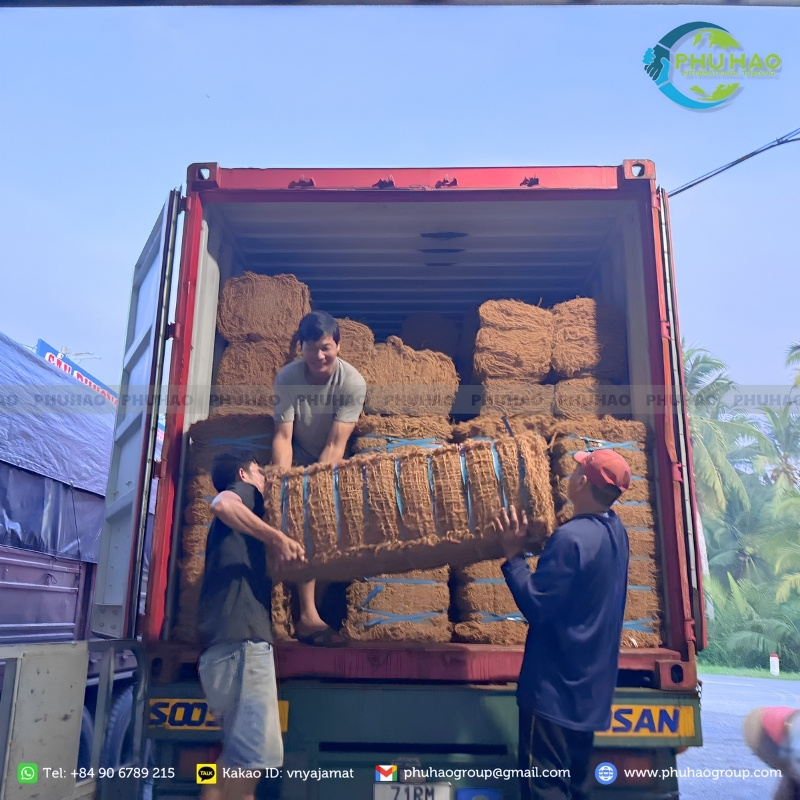
Maintaining technical top clearance and lining floors with absorbent cardboard stops mold formation. Call PHUHAOGROUP at +84 90 6789 215 for standard container loading guidelines
Crews must inspect container shells before loading any rolls. Sweep the floor clean, verify floorboards are dry, and confirm zero light leaks through closed doors. Pinholes or cracked door gaskets allow moisture and sea salt air to blow inside. After stuffing, applying export quarantine fumigation treatments clears out pests and halts fungal spores, securing freight so that a moldy coir net issue does not develop during pre-carriage delays. Checking container weather-tightness remains a proven method to avoid finding a moldy coir net upon arrival.
WATCH MORE: Coir Net Packaging Specifications & Container Loading Information At Phu Hao
How do you measure coir roll core moisture accurately to prevent errors?
Use an industrial moisture meter with penetration probe pins exceeding 15 cm, inserting the needles straight into the center core of the roll.
Does surface white mold rot natural coir mesh fibers?
Fresh white surface mold does not rot fibers immediately; brushing the outer layer clean restores raw fiber durability without losing tensile strength.
Should export bales use PE stretch wrapping or open strapped packaging?
Use open-strapped bales secured with plastic bands because plastic film seals moisture inside, causing thermal build-up and accelerated decay.
Which shipping lanes experience container rain most frequently?
Container rain strikes most heavily along trade routes moving from tropical origins to cold regions, such as shipments from Asia to Europe.
Preventing a moldy coir net outcome does not rely on transit weather luck; it stems from strict control across raw material sun-curing, core moisture monitoring, and methodical container stuffing. Manufacturing teams carry out multi-point quality checks to deliver rolls meeting international standards for tensile strength and natural golden-brown appearance. Processing capabilities and loading standards protect shipments from moldy coir net risks, helping global partners import reliable cargo, improve commercial value, and build lasting business growth.
Contact us for a detailed FOB & CNF quotation:
PHU HAO INTERNATIONAL TRADING CO., LTD (PHUHAOGROUP)
📞 Tel/WhatsApp/WeChat/Zalo: +84 906 789 215
📧 Email: phuhaogroup@gmail.com / henry@phuhaogroup.com
🌐 Website: www.phuhaogroup.com
🏬 Alibaba: phuhaogroup.trustpass.alibaba.com
▶️ YouTube: @phuhaogroup
You have0products in your cart
There are no products in the cart.
Total order price