14 Sep, 2026
The coir net fastening peg rate acts as a decisive geotechnical parameter to secure organic material layers firmly against slope surfaces. When deploying bio-geotechnical surface covers with vegetation mats and natural fiber materials, site engineers must master the calculation methods for the coir net fastening peg rate and associated anchoring components. Calculating anchor spacing precisely neutralizes shallow surface sliding while offering the best conditions for grass seeds to sprout and root deeply into parent soil. The guide below details how to establish accurate rates for each terrain slip condition.
The coir net fastening peg rate reflects the total anchor pegs required per square meter of slope surface added to reinforcement pegs along edges and overlapping seams. This metric integrates the slope slip angle, topsoil shear strength, and mesh aperture size to press the netting tight against the embankment face, stopping erosive runoff.
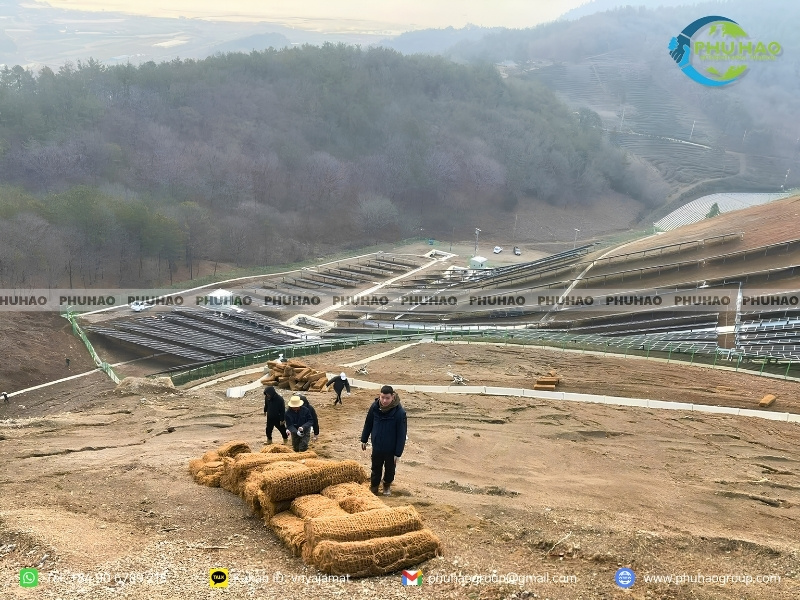
Construction teams must survey slope topography on-site to establish an accurate coir net fastening peg rate for stable, non-shifting ground
When designing transportation embankment reinforcements, field engineers must evaluate soil mechanics to select anchor peg types tailored to specific geologic conditions.
For compacted roadbed fills containing gravel and aggregate, the premier technical choice is 4mm U-shaped steel staples made from cold-drawn or galvanized wire coils. The U-shaped profile drives two steel prongs deep into the subgrade, expanding frictional contact area and resisting surface stripping during heavy storm runoffs. Standard metal legs run 20 to 30 cm long per the baseline coir net fastening peg rate, effectively pinning the coir fibers without fracturing compacted ground structures. When specifying the coir net fastening peg rate for Class III or Class IV hard soils, U-shaped steel staples deliver dependable anchorage.
For eco-infrastructure projects targeting natural environmental restoration, beveled split bamboo stakes measuring 30 to 40 cm long offer an ideal technical substitute. Mature bamboo stalks provide high fiber tensile strength, taking repeated hammer impacts without splintering or shattering. Their ecological benefit rests on natural in-ground decomposition within 3 to 5 years, harmonizing with the natural degradation timeline of coir netting. By the time the stakes break down, dense root networks anchor deeply into the soil profile to sustain long-term slope stability.
Slope angle represents the most critical dynamic variable dictating anchor design specifications for organic netting.
Steeper gradients amplify gravitational shear forces parallel to the embankment face, requiring engineers to adjust anchor frequency following standard geotechnical parameters:
| Slope Grade | Face Inclination Angle | Standard Peg Specification (peg density per m2) |
| Mild Slope (1:2 ratio) | Below 25 degrees | 1.0 to 1.5 pegs/m2 |
| Moderate Slope (1:1.5 ratio) | 25 to 35 degrees | 2.0 to 2.5 pegs/m2 |
| Steep Slope (1:1 ratio) | Above 35 degrees | 3.0 to 4.0 pegs/m2 (reinforced along trench edges) |
Along perimeter edges, berm drains, and overlapping joints, double the coir net fastening peg rate to prevent heavy gusts from uplifting loose net edges off the slope face.
To prepare an accurate bill of quantities for bidding, calculate total anchoring peg requirements using this formula:
Total Peg Quantity = (Net Netting Installation Area × coir net fastening peg rate) + Seam and Trench Reinforcement Pegs + Field Wastage Allowance (3% – 5%)
Accurately computing the coir net fastening peg rate during the shop-drawing phase allows contractors to maintain budget discipline and eliminate unexpected supply shortages that derail project schedules.
READ MORE: Coir Net Export To South Korea: Roll Dimensions And 40HC Container Packing Capacity
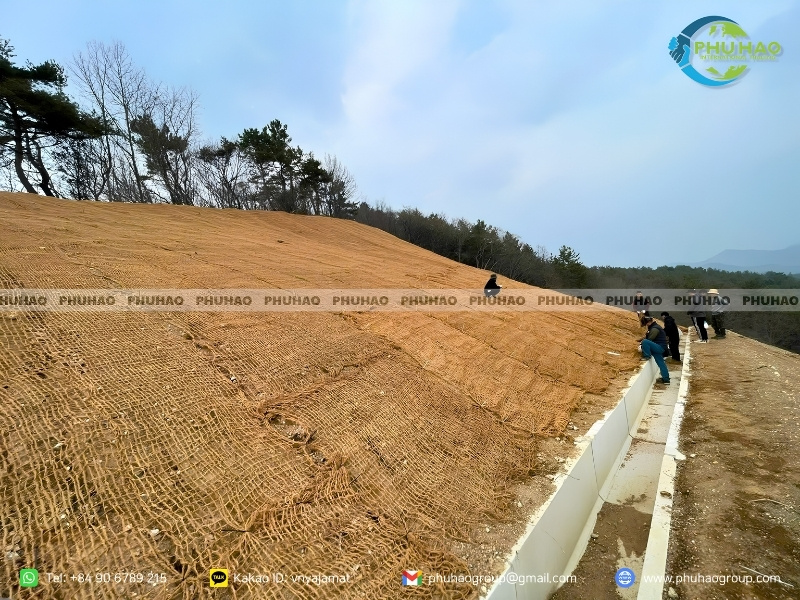
Driving anchor pegs ensures flat surface adhesion of coir net geotextiles on embankments
Beyond bare quantities, precise driving techniques directly dictate the shear resistance of the entire revetment system.
A frequent site error is driving pins perpendicular to the inclined ground. Sound technical execution requires driving pegs vertically plumb or inclined 15 to 20 degrees up-slope against the fall line. This orientation maximizes peg pull-out resistance, establishing a sturdy mechanical interlock when topsoil reaches saturated unit weight. Correct alignment enables the engineered coir net fastening peg rate to deliver its intended holding performance.
At crests and toe berms, tuck coir roll heads into pre-excavated anchor trenches measuring at least 30 cm wide by 30 cm deep. Site crews apply the project’s coir net fastening peg rate to peg the trench base every 40 to 50 cm before backfilling and compacting the ground thoroughly. This locking edge anchors the overall revetment run and stops movement.
Distribute all intermediate slope anchors in a staggered diamond (quincunx) pattern rather than linear columns, which create vertical rills and erosion troughs. Measure row and column offsets with string lines in full accordance with the designated coir net fastening peg rate to preserve uniform contact between net and subgrade.
When assembling an auxiliary materials estimate for roadworks or water conservancy projects, engineers balance net quantities, staples, tie wire, and grass seed mixes. Applying the right coir net fastening peg rate helps contractors finish projects on schedule while ensuring slope structures resist severe storm seasons. Adopting green embankment armor provides a durable, nature-based replacement for rigid concrete revetments.
WATCH MORE: Installing Coir Nets
Why are anchor pegs required when laying erosion-control coir netting on slopes?
Pegs pin the netting flush against the soil, resisting hydraulic uplift and surface slips.
Which option works better: U-shaped steel staples or split bamboo stakes?
Steel pins perform best in dense, compacted soils, whereas bamboo stakes maximize environmental benefits by biodegrading alongside natural coir netting fibers.
Does coir netting blister or slide down slopes after rainstorms because of poor pinning?
Yes. Net detachment stems from insufficient crest-trench pinning or failing to follow the specified coir net fastening peg rate.
How should contractors secure coir nets when hitting hard rock where U-pins cannot penetrate?
Drill pilot holes, insert steel rock pins with large distribution washers, or anchor the netting locally with sandbags.
How long do bamboo stakes last before decomposing, and do they harm the turf layer?
Bamboo breaks down within 3 to 5 years, decomposing harmlessly into organic humus that nourishes emerging root systems.
For infrastructure contractors and landscape engineering firms operating in South Korea, managing the coir net fastening peg rate from survey design through field execution directly governs embankment structural life. Engineers must adjust anchor designs to slope inclinations, soil properties, and runoff discharge velocities. This rigorous approach aligns with strict green building standards while optimizing overseas freight and on-site labor overhead. Maintaining a disciplined coir net fastening peg rate protects sloped assets through demanding freeze-thaw and wet monsoon cycles.
Contact us for a detailed FOB & CNF quotation:
PHU HAO INTERNATIONAL TRADING CO., LTD (PHUHAOGROUP)
📞 Tel/WhatsApp/WeChat/Zalo: +84 906 789 215
📧 Email: phuhaogroup@gmail.com / henry@phuhaogroup.com
🌐 Website: www.phuhaogroup.com
🏬 Alibaba: phuhaogroup.trustpass.alibaba.com
▶️ YouTube: @phuhaogroup
You have0products in your cart
There are no products in the cart.
Total order price