14 Sep, 2026
Coir net products woven entirely from natural Ben Tre coconut husk fiber deliver superior mechanical toughness and high tensile strength. The biodegradable fiber matrix decomposes into rich organic humus, preventing topsoil stripping while retaining moisture to accelerate seed germination. Backed by precision manufacturing capacity tailored for export, PHUHAOGROUP delivers green engineering solutions that secure long-term geological stability and protect local ecosystems.
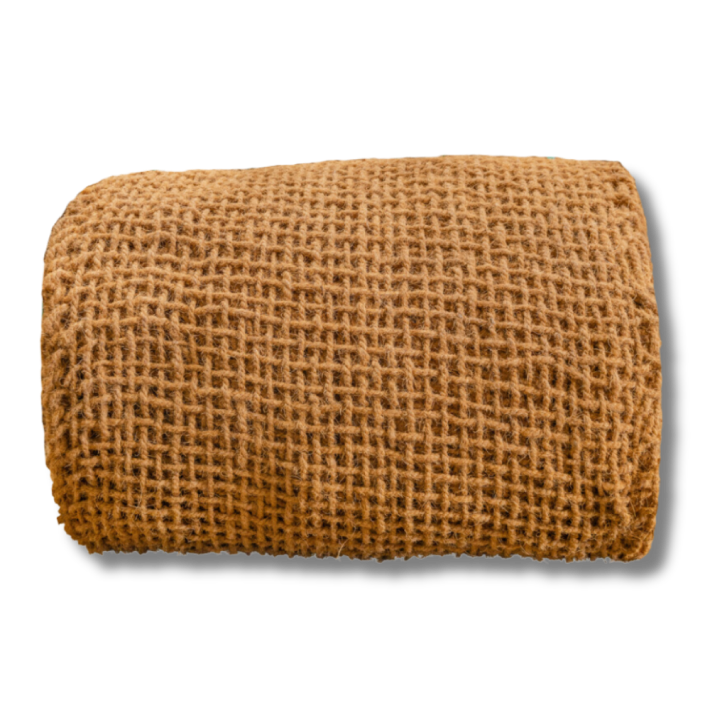
Coir net materials are open-mesh biological geotextile blankets woven from natural twisted coconut coir twine. The open-mesh structure integrates industrial mechanical spinning technology to dissipate raindrop kinetic energy and stabilize engineered slopes across ecological transport infrastructure projects.
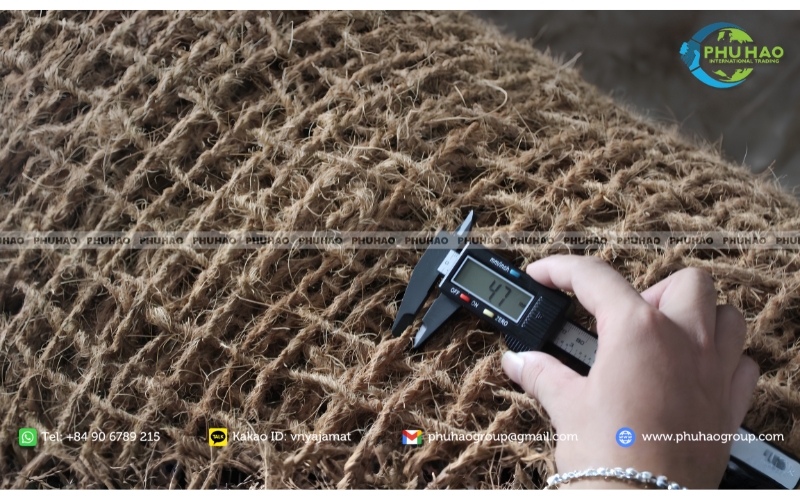
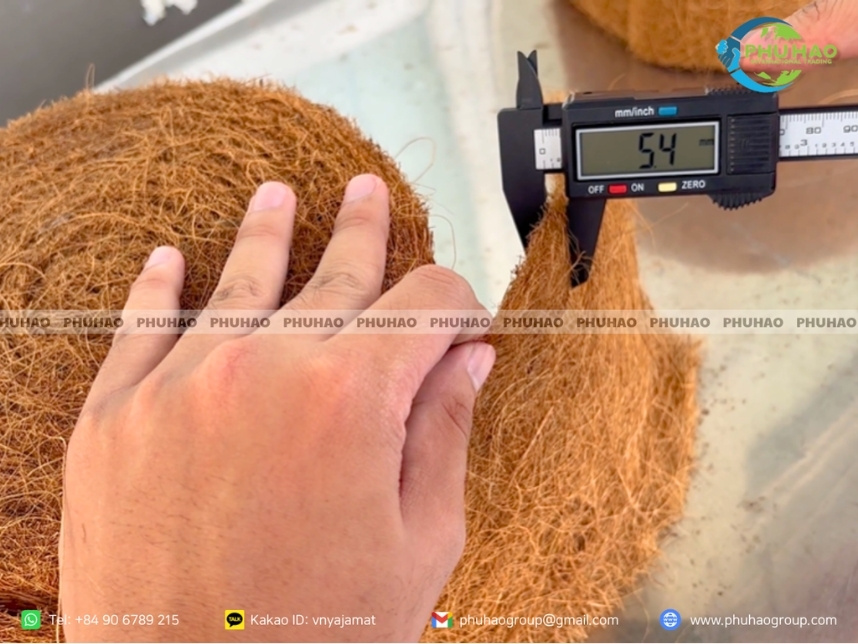
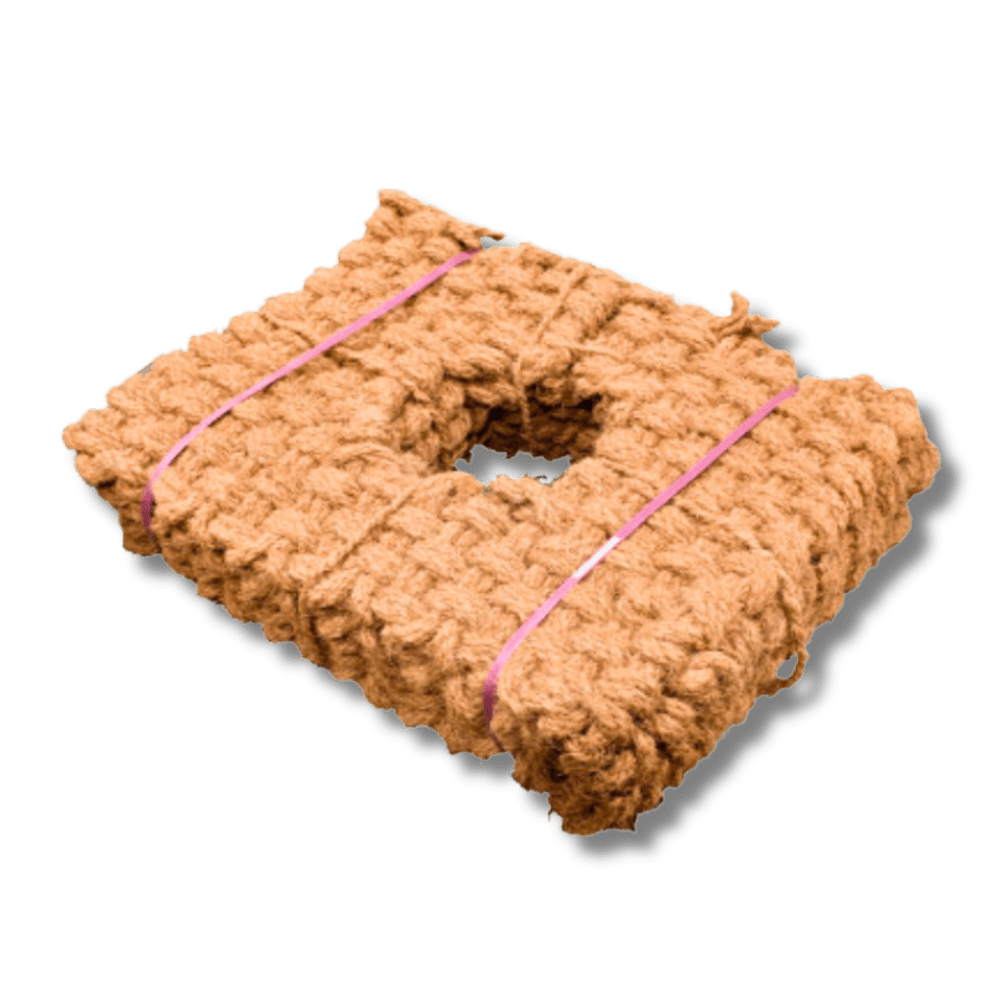
Coir net rolls undergo rigorous tensile strength and twine thickness inspections prior to export baling at the Phu Hao factory
Every export coir net consignment manufactured by PHUHAOGROUP strictly complies with the following physical and mechanical quality standards:
| Technical Parameter | Standard 36 x 24 Lines | Standard 40 x 28 Lines | Inspection Notes |
| Roll Dimensions | 1.0 m x 20 m or 2.0 m x 20 m | 1.0 m x 20 m or 2.0 m x 20 m | Customizable upon request |
| Twine Specification | Single x Single, Single x Double, or Double x Double | Premium Double x Double | Mechanically twisted industrial twine |
| Mesh Thickness | 2.0 mm – 3.0 mm | 2.5 mm – 3.5 mm | Measured with specialized digital calipers |
| Basis Weight (GSM) | 225 – 400 g/m² | 450 – 700 g/m² | Weight tolerance ≤ 5% |
| Moisture Content | Below 15% | Below 15% | Thermal drying suppresses mold |
| Decomposition Time | 3 – 5 years | 3 – 5 years | Naturally degrades into biomass |
The primary export coir net standard measures 2 m wide by 20 m long (covering 40 m²), with a roll weight between 7 kg and 9 kg. The 36 x 24 lines configuration stabilizes slopes under 30 degrees, whereas the 40 x 28 lines density reinforces cut-and-fill slopes subjected to heavy hydraulic discharge.
Mechanically twisted double yarn construction provides high bidirectional tensile strength ratings. The robust woven mesh reliably withstands wind shear forces and downslope soil slips while preventing mechanical elongation.
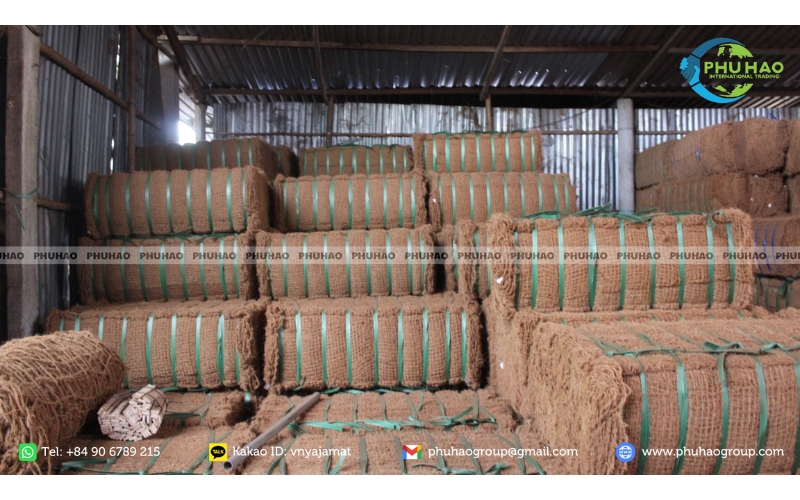
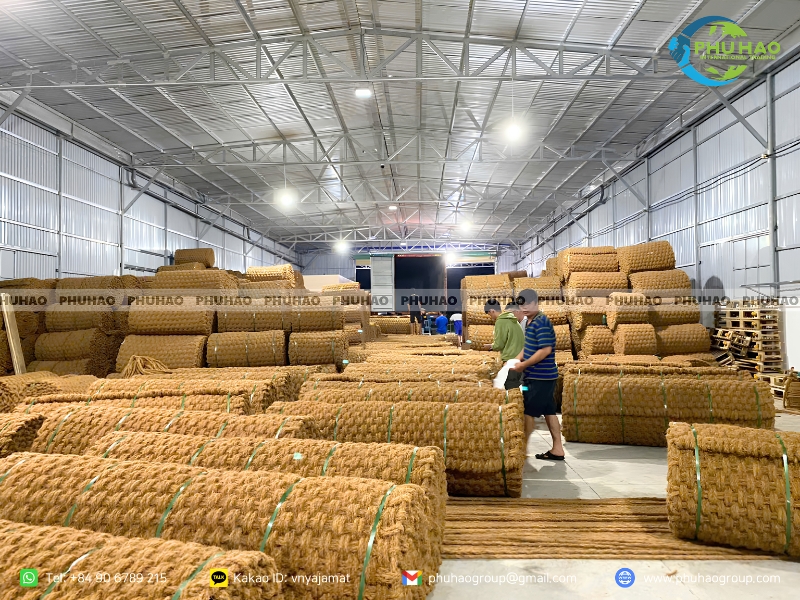
Coir net products at PHUHAOGROUP undergo thorough processing to satisfy international export quality standards
Slope failures originate directly from raindrop kinetic energy combined with surface runoff velocity. Deploying a coir net creates a resilient hydraulic buffer that breaks external dynamic loads.
During intense downpours, high-velocity rain strikes exposed hillsides, dislodging soil aggregates. Installed across the embankment, a geotextile coir mat features a coarse fiber network that shatters heavy droplets into fine spray. This protective coir net absorbs kinetic impact, protects topsoil layers, and keeps hydroseeded species in place.
Excess overland flow washes away fertile topsoil once surface water reaches critical velocity. Incorporating erosion control coir fiber blankets creates thousands of micro-check dams across the grade, increasing hydraulic roughness and reducing runoff velocities by up to 70%. The coir net filters fine sand particles and organic silt, establishing a nutrient-rich seedbed that anchors rooting systems deep into the subsoil.
Long-term slope stabilization requires field contractors to execute this installation sequence with precision:
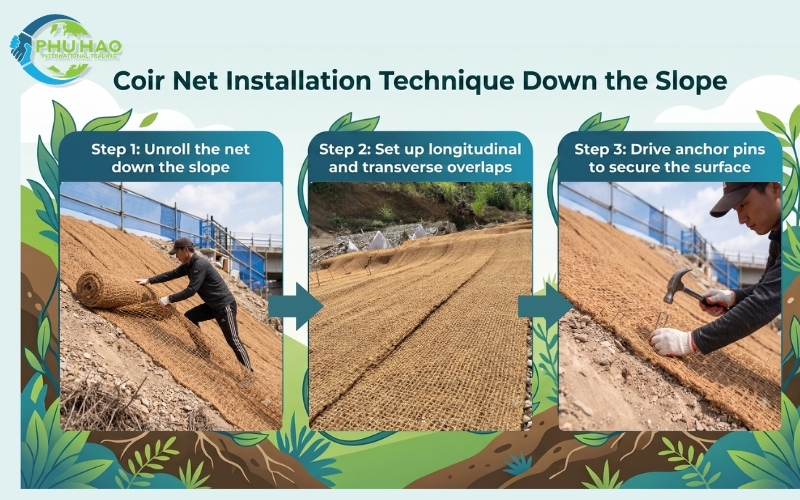
Standard field installation sequence for rolling coir net down an engineered slope
Supplying projects in South Korea, Japan, and European markets requires competitive sea freight planning alongside lean manufacturing. Standardizing slope designs with coir net materials cuts long-term civil maintenance costs substantially.
Commercial export pricing for a coir net reflects GSM basis weight, single- or double-yarn weave styles, and logistical shipping routes. Operating out of Cat Lai Port, PHUHAOGROUP maintains a consistent throughput of 10 containers monthly with rapid 1-to-2-day dispatch readiness, linking directly to weekly sailings reaching Busan and Incheon within 5 to 7 transit days. We provide complete export clearance documentation, including Certificate of Origin (C/O), Phytosanitary Certificate, and fumigation treatments compliant with the rigorous Korean KS standard. Review our representative wholesale rates below:
| Roll Dimensions | Weaving Construction | Weight / Roll | FOB Cat Lai Price (USD/roll) | CNF Busan / Incheon Price (USD/roll) |
| 1.0 m x 20 m | 36 x 24 lines, double x single | 5.0 kg | 3.80 | 4.25 |
| 2.0 m x 20 m (Standard) | 36 x 24 lines, double x single | 9.0 kg | 7.00 | 7.50 |
| 1.0 m x 20 m | 40 x 28 lines, double x single | 10.0 kg | 8.25 | 8.50 |
| 2.0 m x 20 m | 40 x 28 lines, double x single | 18.0 kg | 15.00 | 15.50 |
| For custom product specifications, please contact PHUHAOGROUP directly to receive an itemized quote. | ||||
Note: The prices above serve as reference estimates based on current raw material costs and ocean freight rates. Actual spot quotes vary with maritime shipping surcharges and contract volumes.
WATCH MORE: Details About the Coir Net
Natural coir products present bulk volume challenges that inflate maritime freight bills under loose loading methods. At the PHUHAOGROUP central export depot, heavy-duty hydraulic baling presses compress inventory under two standard packing configurations: 5-roll bundles loading 1,500 rolls per 40HC container, or ultra-compressed 6-roll bundles maximizing payload to 1,848 rolls per 40HC. Every compressed bale is strapped with heavy-duty virgin polymer bands and labeled for complete supply chain traceability, lowering international landing costs by 20% to 30% per square meter of slope coverage.
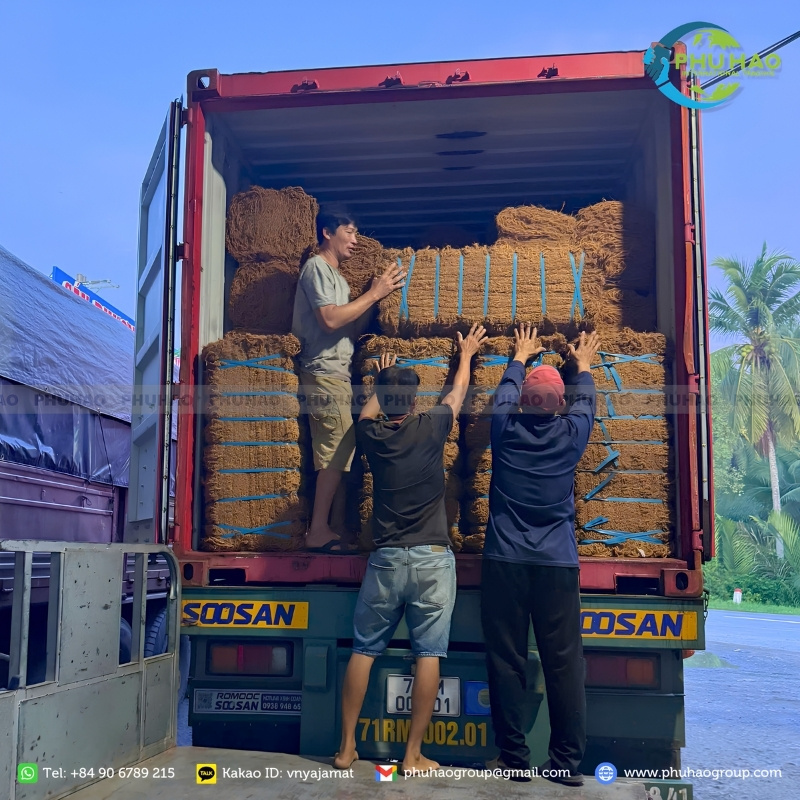
PHUHAOGROUP optimizes 40HC stuffing layouts for export shipments to minimize maritime logistics costs for international contractors
Should civil projects install a coir net or synthetic plastic geogrid for slope revegetation?
Choose a coir net because the natural fiber decomposes into nutrient humus, promotes root anchorage, and leaves zero synthetic microplastic residue behind.
Do contractors need to remove the coir net once hillside grass takes root?
No removal is necessary because the mesh breaks down naturally, converting into organic soil conditioning matter that enriches deep root zones.
How long does an exposed coir net take to decompose outdoors?
The material biodegrades completely within 3 to 5 years depending on local rainfall, solar radiation, and soil moisture conditions.
Specifying coir net materials within slope engineering designs produces outstanding ecological value for highways, dikes, and hillside infrastructure. Supported by 8 centralized manufacturing workshops throughout the Ben Tre coconut production hub and a consistent capacity of 10 containers monthly, PHUHAOGROUP reliably meets export delivery schedules with certified mechanical quality. Deploying technical-grade coir net solutions alongside professional installation delivers lasting return on investment, secures structural ground stability, and preserves surrounding ecosystems.
Contact us for a detailed FOB & CNF quotation:
PHU HAO INTERNATIONAL TRADING CO., LTD (PHUHAOGROUP)
📞 Tel/WhatsApp/WeChat/Zalo: +84 906 789 215
📧 Email: phuhaogroup@gmail.com / henry@phuhaogroup.com
🌐 Website: www.phuhaogroup.com
🏬 Alibaba: phuhaogroup.trustpass.alibaba.com
▶️ YouTube: @phuhaogroup
You have0products in your cart
There are no products in the cart.
Total order price