03 Sep, 2026
The coir mat container loading process serves as a vital link in the eco-friendly material export supply chain from Ben Tre to demanding global markets. Reaching the 28-ton payload threshold during the coir mat container loading process for 40ft HC containers requires precise coordination among fiber compression techniques, weight distribution layouts, and cargo lashing methods. Each coir mat unit placed inside the container demands exact calculations for cubic volume and axle center-of-gravity distribution. This precision maximizes shipping volume, eliminates mechanical damage, and protects logistics margins for businesses.
Coir mat container loading process for 40ft HC comprises several systematic steps: inspecting container cleanliness and watertight integrity to shield every mat roll, stacking rolls horizontally in tightly packed layers from the interior toward the door, and completing the dispatch with bolt seal locking.
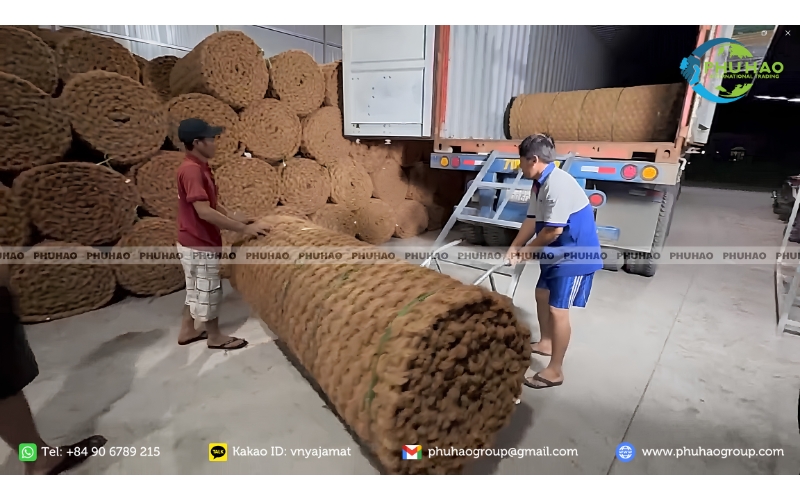
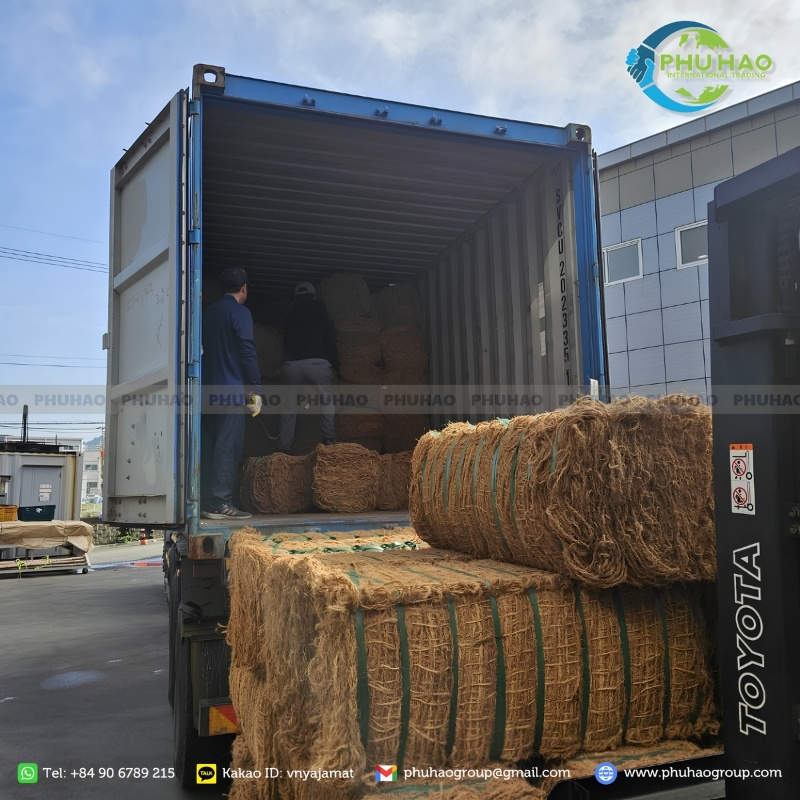
The coir mat container loading process for 40ft HC at the PHUHAOGROUP plant helps optimize Busan ocean freight rates
Space arrangement inside a 40HC coir mat container directly determines whether the shipment achieves maximum allowable payload.
When packing heavy cargo close to the 28-ton limit (the maximum payload of a 40HC container), the entire load’s center of gravity must align precisely over the center of the chassis. Shifting excessive weight toward the front wall overloads the tractor drive axle; concentrating weight near the container doors causes hazardous loss of steering control during turns.
For this reason, the coir mat container loading process for 40ft HC units requires evenly distributed floor weight per square meter to prevent localized pressure that could bend the bottom crossmembers of the container undercarriage.
Because rolls have a circular cross-section, column stacking in a standard grid leaves up to 21.5% wasted void space between contact points. Applying a honeycomb staggered arrangement seats the second layer directly into the V-shaped grooves formed by the bottom rolls. This technique delivers clear benefits:
During the coir mat container loading process, workers secure each roll using heavy-duty PP plastic strapping clips to maintain consistent compression.
Executing the coir mat container loading process takes into account the standard internal dimensions of a 40HC container: Length 12.03m, Width 2.35m, and Height 2.69m. Depending on the roll specifications in the order, packing engineers calculate the handling layout:
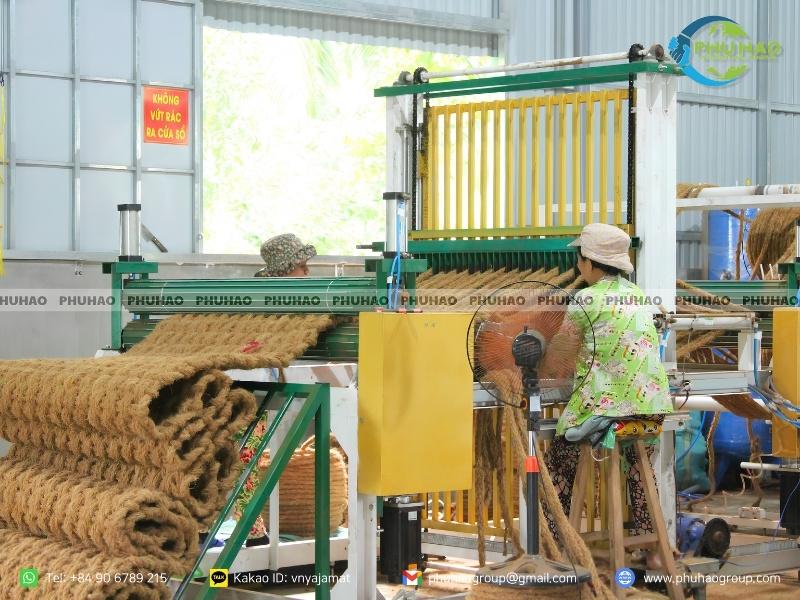
Applying specialized coir roll pressing machinery prior to stuffing significantly reduces roll diameter, allowing additional stacked layers within the hold.
WATCH MORE: LOADING PROCESS & CONTAINER PACKING SPECIFICATIONS AT PHUHAO FACTORY
Every preparation stage acts as a mandatory prerequisite in the coir mat container loading process to meet export clearance standards.
Operating the coir mat container loading process systematically increases handling productivity while safeguarding product integrity.
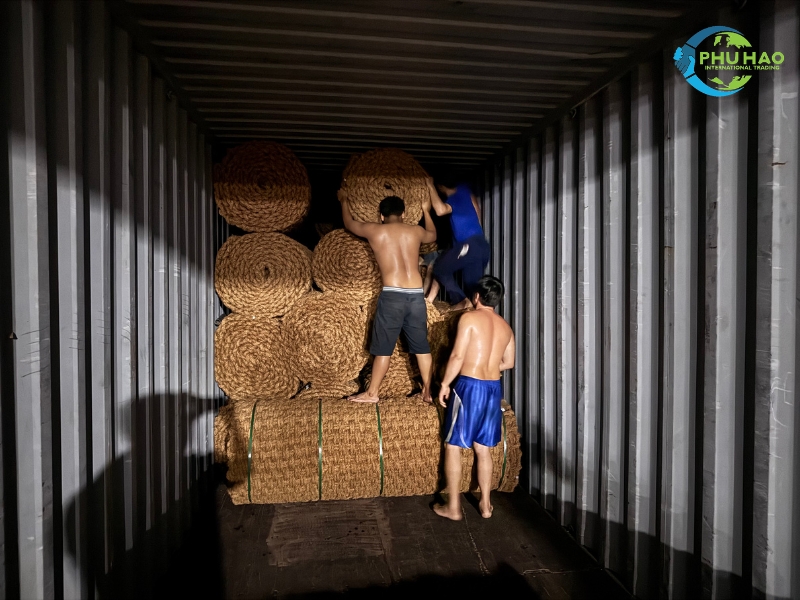
Manual loading crews transfer rolls deep into the container, stacking to specification to prevent mechanical deformation
How many coir mat rolls of 1.0m, 1.2m, and 1.5m widths fit into a 40ft High Cube container?
Under standard coir mat container loading process parameters, a 40HC holds approximately 165 rolls of 1.0m width, 141 rolls of 1.2m width, or 113 rolls of 1.5m width (based on 10m length and 35mm thickness).
Should you use forklifts or manual labor when loading coir mat rolls into a 40HC container?
During the coir mat container loading process, use forklifts to stage rolls at the container’s threshold, while crews inside secure them and maximize volume.
How do you prevent coir mats on the container floor from flattening or deforming?
Maintain moisture levels below 15% during weaving, and secure high-tensile strapping bands around the rolls before loading to preserve their cylindrical shape.
Applying integrated technical solutions throughout the 40ft HC coir mat container loading process enables exporters to reach the 28-ton maximum payload while eliminating roll deformation during long ocean transits. PHUHAOGROUP enforces rigorous quality control measures, starting from the processing of raw fibers to the final export packaging. Adhering to strict coir mat container loading process standards maintains the physical integrity of every roll, strengthens brand trust, and delivers lasting value to international partners.
Contact us for a detailed FOB & CNF quotation:
PHU HAO INTERNATIONAL TRADING CO., LTD (PHUHAOGROUP)
📞 Tel/WhatsApp/WeChat/Zalo: +84 906 789 215
📧 Email: phuhaogroup@gmail.com / henry@phuhaogroup.com
🌐 Website: www.phuhaogroup.com
🏬 Alibaba: phuhaogroup.trustpass.alibaba.com
▶️ YouTube: @phuhaogroup

You have0products in your cart
There are no products in the cart.
Total order price